
鄂尔多斯盆地长7段页岩油藏孔隙度、渗透率极低,一次采收率不足10%。本文利用CMG-GEM建立二维单裂缝对称模型,模拟压裂后“连续注入30 d+焖井30 d”的CO₂-EOR全过程,系统对比四种机制情景:①纯对流;②对流+地球化学反应;③对流+分子扩散;④三者全耦合。引入“CO₂波及效率”(CO₂摩尔分数≥1 %区域面积比)和“压力波及效率”(压升≥0.1 MPa区域面积比)两项指标,定量评价分子扩散与地球化学反应对CO₂运移及压力传播的影响,并对注入压力、注入速率、焖井时间、渗透率、温度、原始地层压力等6个参数进行敏感性分析。研究为页岩油藏压裂后CO₂-EOR参数优化提供理论依据。
CMG软件应用情况
- 平台:CMG-GEM(组分-地球化学耦合模拟器)
- 功能利用
– 组分模型:9种拟组分,Peng-Robinson状态方程,Winprop模块校正PVT与CO₂膨胀实验数据,偏差<5 %。
– 分子扩散:调用Sigmund相关式(油相)与Wilke-Chang相关式(水相),自动计算二元扩散系数并考虑浓度梯度。
– 地球化学反应:嵌入EQS数据库,考虑CO₂-水-岩石平衡反应与方解石溶解/沉淀动力学,按过渡态理论计算反应速率,实时更新孔隙度并采用Kozeny-Carman方程修正渗透率。
– 网格:2D单裂缝对称单元,整体尺寸110 m×350 m×20 m,局部对数加密(LS-LR)网格2 m×2 m×20 m,确保裂缝-基质界面质量交换精度。
– 运算流程:先模拟1年衰竭生产(定井底流压10 MPa)→引入人工裂缝→连续注入30 d→焖井30 d,全程封闭边界。
主要结论
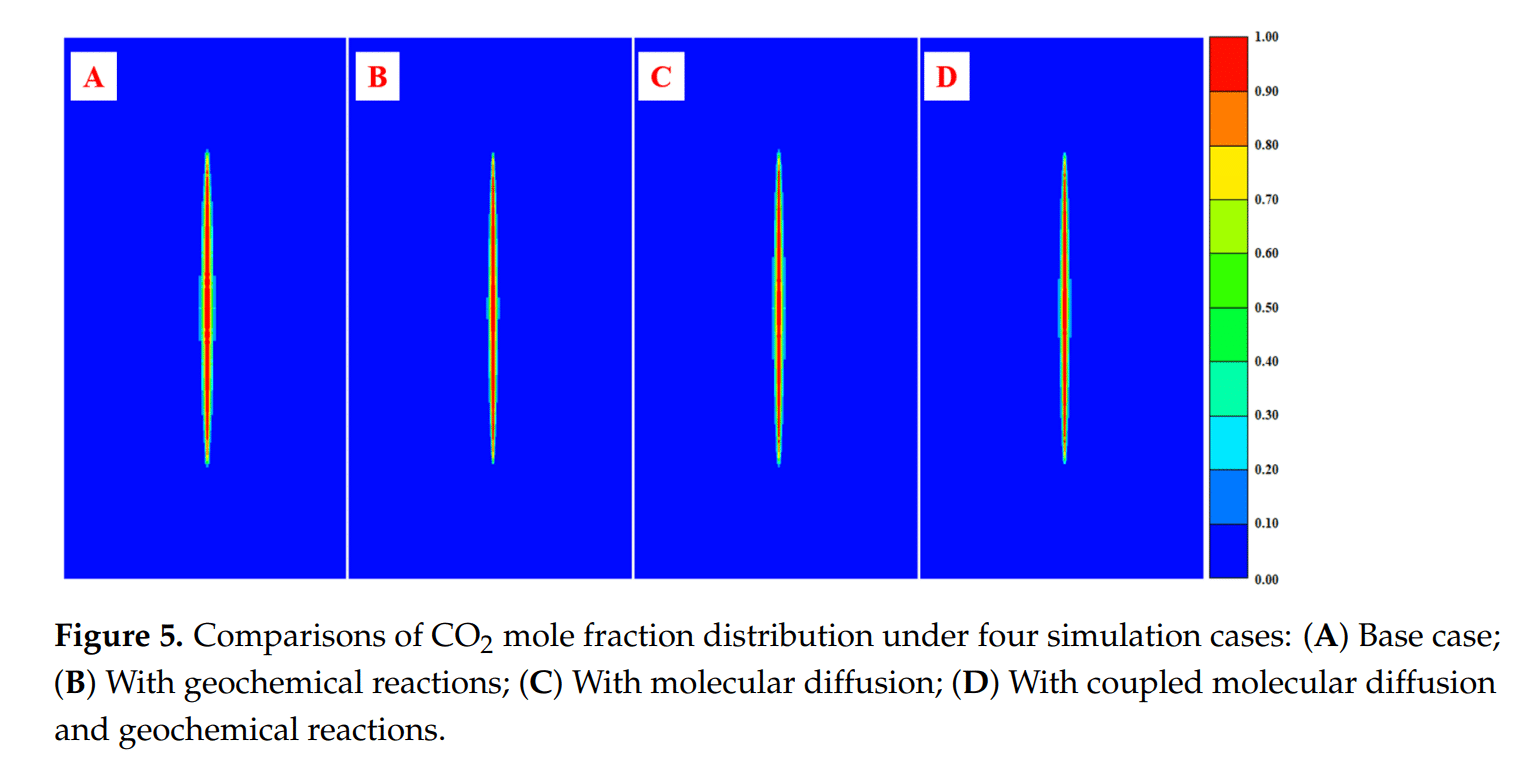
- 分子扩散在焖井阶段成为CO₂进入基质的主导机制,可将CO₂波及效率提高约0.17 %;地球化学反应因消耗CO₂降低浓度梯度,使波及效率下降约0.3 %;两者耦合后净降幅约0.2 %。
- 在60 d短周期内,压力传播主要受水力扩散系数控制,分子扩散与地球化学反应对其影响可忽略,各情景压力波及效率差异<0.5 %。
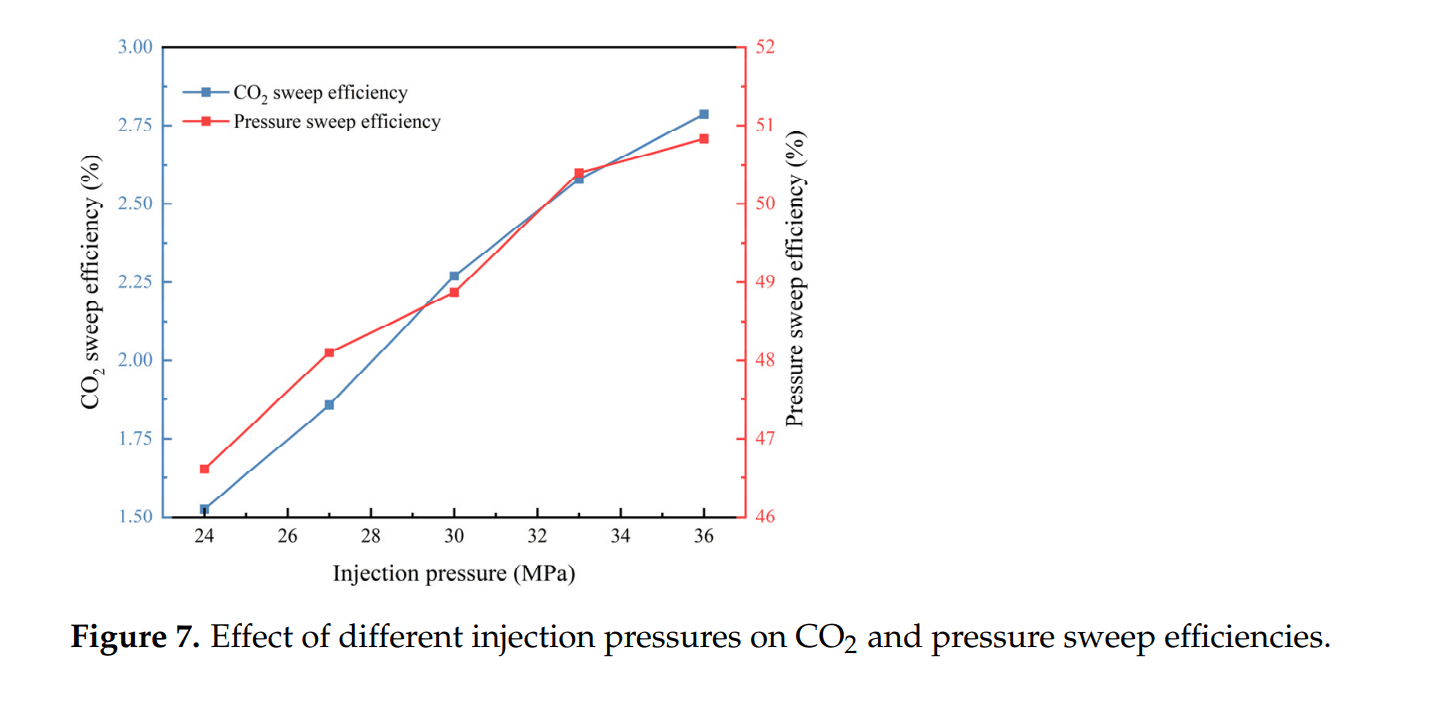
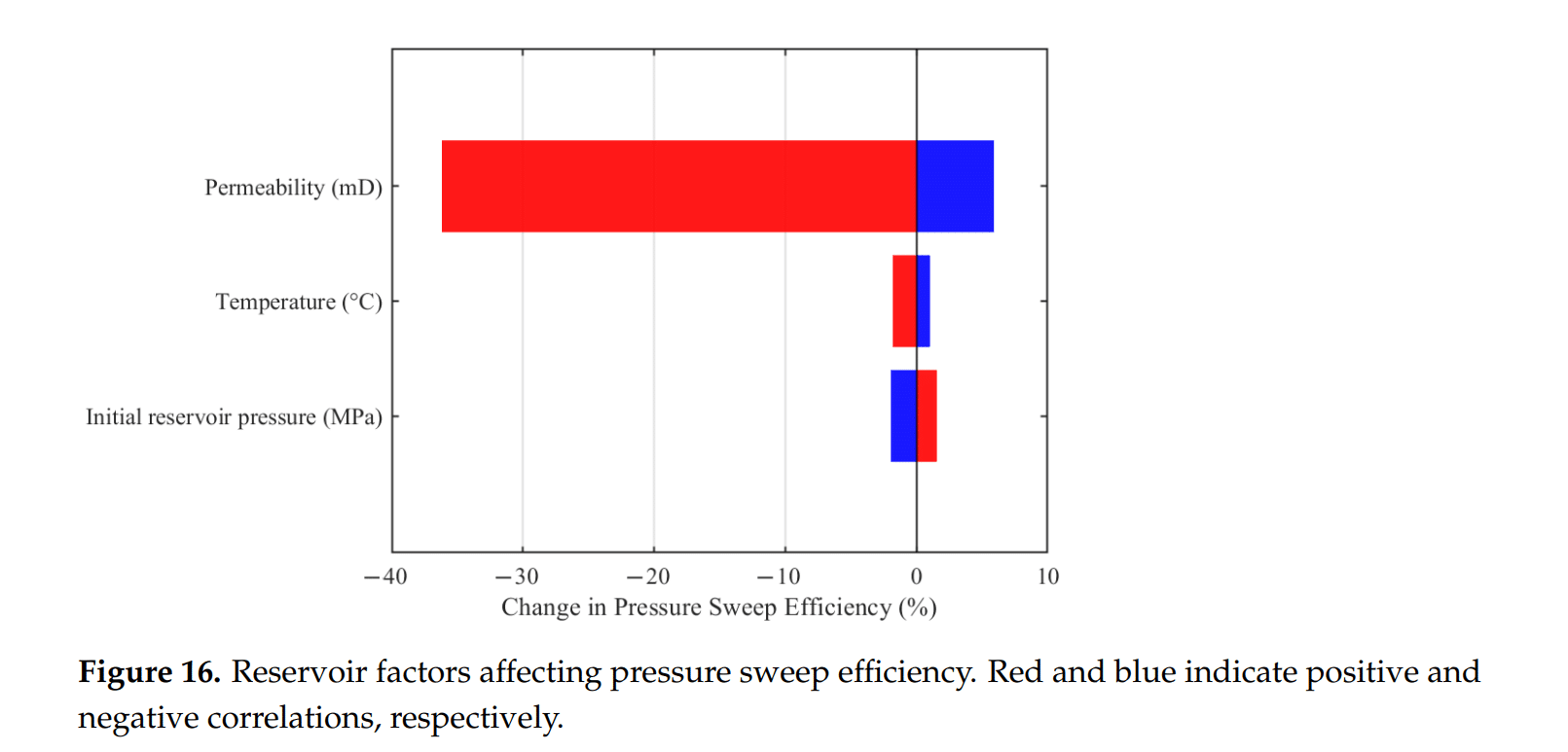
- 注入压力与渗透率分别是控制CO₂波及效率和压力波及效率的最关键因素;注入速率、焖井时间、温度次之;原始地层压力影响最小。
- 研究结果为压裂后CO₂-EOR的现场注入压力、速率及焖井时间优化提供了量化依据,但受限于2D单裂缝、单矿物反应和短周期模拟,后续需扩展至3D多裂缝、多矿物及长周期评价。
作者单位
西安石油大学石油工程学院
Abstract
Unconventional shale oil reservoirs, characterized by ultra-low porosity and permeability, severely constrain oil recovery. CO2-enhanced oil recovery (CO2-EOR) following hydraulic fracturing is an effective approach that combines incremental oil recovery with long-term CO2 storage. However, CO2 transport in the fracture–matrix system is complex, especially when molecular diffusion and geochemical reactions are coupled. This study conducts numerical simulations on a representative shale reservoir in the Ordos Basin, incorporating both mechanisms under post-fracturing injection–soaking conditions. The results show that molecular diffusion enhances CO2 mass transfer across the fracture–matrix interface, increasing the final CO2 sweep efficiency by 0.17 percentage points relative to convection alone, whereas geochemical reactions reduce it by about 0.3 percentage points. When both mechanisms coexist, the net effect is a decrease of approximately 0.2 percentage points in CO2 sweep efficiency. In contrast, pressure sweep efficiency differs by less than 0.5 percentage points among all cases and stabilizes near 47%, suggesting that pressure propagation is only weakly affected by diffusion and reactions. Sensitivity analysis reveals that, among operational parameters, injection pressure and injection rate strongly affect CO2 sweep efficiency, whereas soaking time governs pressure propagation. Among reservoir parameters, permeability has the most pronounced influence on both CO2 and pressure sweep efficiencies, followed by temperature, while initial reservoir pressure has minimal impact. This work quantitatively elucidates the coupled roles of molecular diffusion and geochemical reactions in shale reservoirs and provides practical guidance for optimizing post-fracturing CO2-EOR operations.
