
Hydrogen storage in depleted gas reservoirs with carbon dioxide as a cushion gas: Exploring a lateral gas separation strategy to reduce gas mixing
大规模氢气(H₂)储存在枯竭的油气藏中是一种利用现有能源基础设施解决可再生能源间歇性的实用方法。垫气通常需要大量的初始投资,尤其是当使用昂贵的氢气时。更便宜的替代品,如二氧化碳(CO₂)或原位甲烷(CH₄),可以降低成本,并且在CO₂的情况下,还可以与碳捕获和储存(CCS)系统集成。
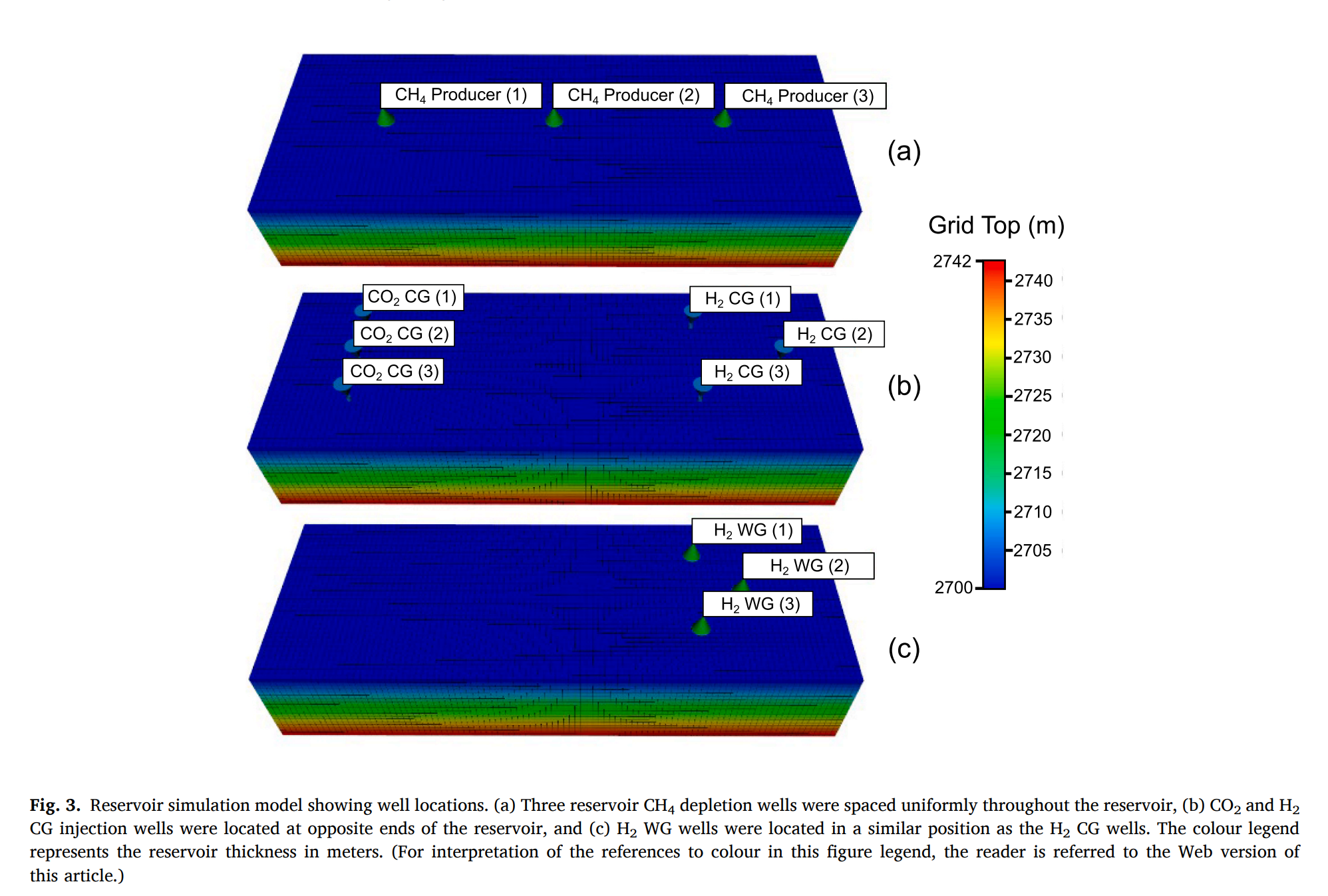
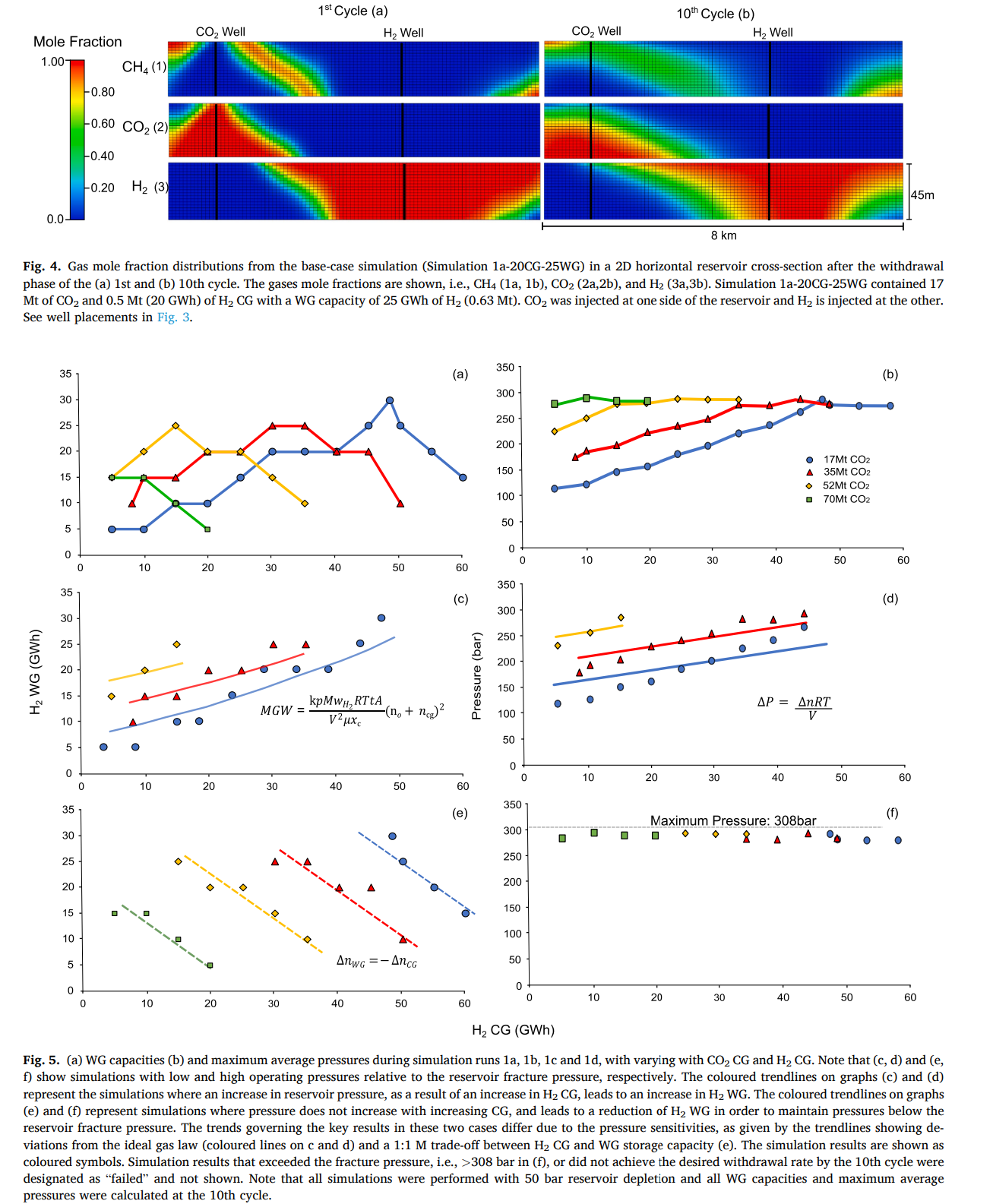
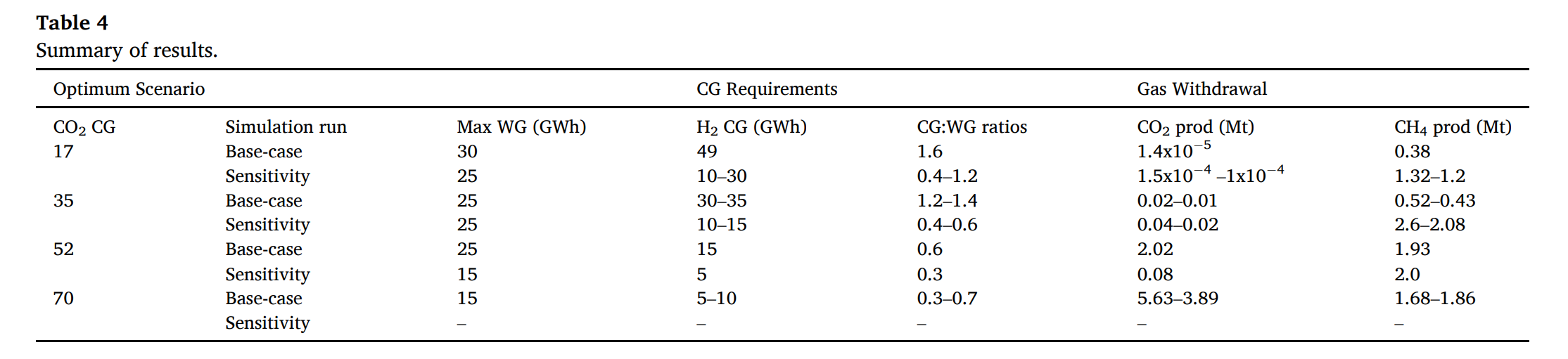
本研究通过数值模拟一系列储存在横向广泛分布的气藏中的场景(例如北海南部的气藏),探索了垫气和工作气的动态变化。在所有模拟中,垫气和工作气在侧向上被分离,以限制接触面积,从而减少混合。本研究提供了关于(i)CO₂储存能力和H₂提取能力的估算,(ii)宏观尺度流体动力学,以及(iii)气体混合趋势对H₂纯度影响的宝贵见解。结果强调了CO₂储存量与H₂提取量和纯度之间的关键权衡。
CMG软件应用情况
本文使用了CMG(Computer Modelling Group)软件进行数值模拟研究。CMG是一个商业化的有限差分组成模拟器,基于状态方程物理,广泛应用于能源行业的大规模气藏系统模拟。研究中使用了Peng-Robinson立方状态方程,能够准确模拟在变化的气藏压力和温度条件下流体及其混合物的性质。通过CMG软件,研究者模拟了在枯竭气藏中利用CO₂作为垫气进行H₂储存的过程,分析了不同条件下气体混合、压力变化和储存能力等关键参数。CMG软件的应用为研究提供了强大的数值模拟支持,帮助研究者更好地理解和优化H₂储存过程。

Abstract
Large-scale H2 storage in depleted hydrocarbon reservoirs offers a practical way to use existing energy infrastructure to address renewable energy intermittency. Cushion gases often constitute a large initial investment, especially when expensive H2 is used. Cheaper alternatives such as CO2 or in-situ CH4 can reduce costs and, in the case of CO2, integrate within carbon capture and storage systems. This study explored cushion and working gas dynamics through numerically modelling a range of storage scenarios in laterally extensive reservoirs – such as those in the Southern North Sea. In all simulations, the cushion and working gases were separated laterally to limit contact surface area, and therefore mixing. This work provides valuable insights into (i) capacity estimations of CO2 storage and H2 withdrawal, (ii) macro-scale fluid dynamics, and (iii) the effects of gas mixing trends on H2 purity. The results underscore key trade-offs between CO2 storage volumes and H2 withdrawal and purity.
作者单位
- 英国开放大学工程与创新学院
- 英国爱丁堡大学地球科学学院
