
Geologic structure and multiphase flow effects on compressed air energy storage stability
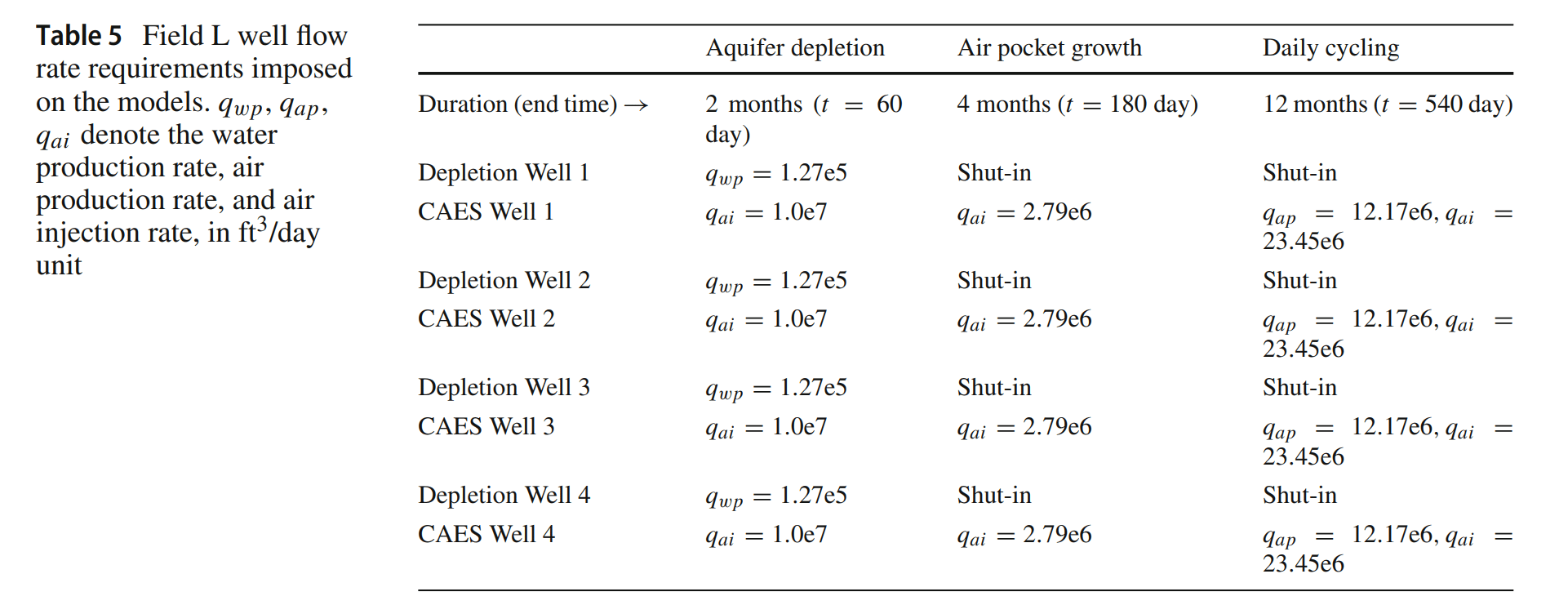
风、光等可再生能源日波动大,急需大规模长时储能。利用地下含水层储存压缩空气(CAES)可平滑出力,但空气囊的压力-位置稳定性、空气-水突破风险及产水动态尚缺系统认知。本文基于美国加州萨克拉门托盆地(Field A,水平层状)、意大利波河平原储气库(Field L,楔形尖灭)及北意背斜油田(Field E,穹隆)三类真实地质构造,建立非等温空气-水两相两组分多物理场模型,提出“三步法”作业流程:①含水层衰竭(同步抽水注气)→②空气囊长大(停抽继续注气)→③日循环(白天8 h注气、夜间12 h采气)。研究为CAES选址、井距、射孔方案及产水处理成本评估提供直接依据。
CMG软件应用情况
- 平台:CMG-STARS (非等温、两相、两组分模型)
- 关键设置
– 组分:空气(气)+水(液),溶解度忽略;气相Z因子0.9614,热物性随温度-压力更新。
– 相对渗透率:采用 Brooks-Corey 型曲线,忽略毛管压力(高渗-大尺度)。
– 能量方程:开启非等温,岩石/流体导热、对流、压缩热全部耦合;注气温度140 °F,热膨胀应力评估≈0.4 MPa ℃⁻¹。
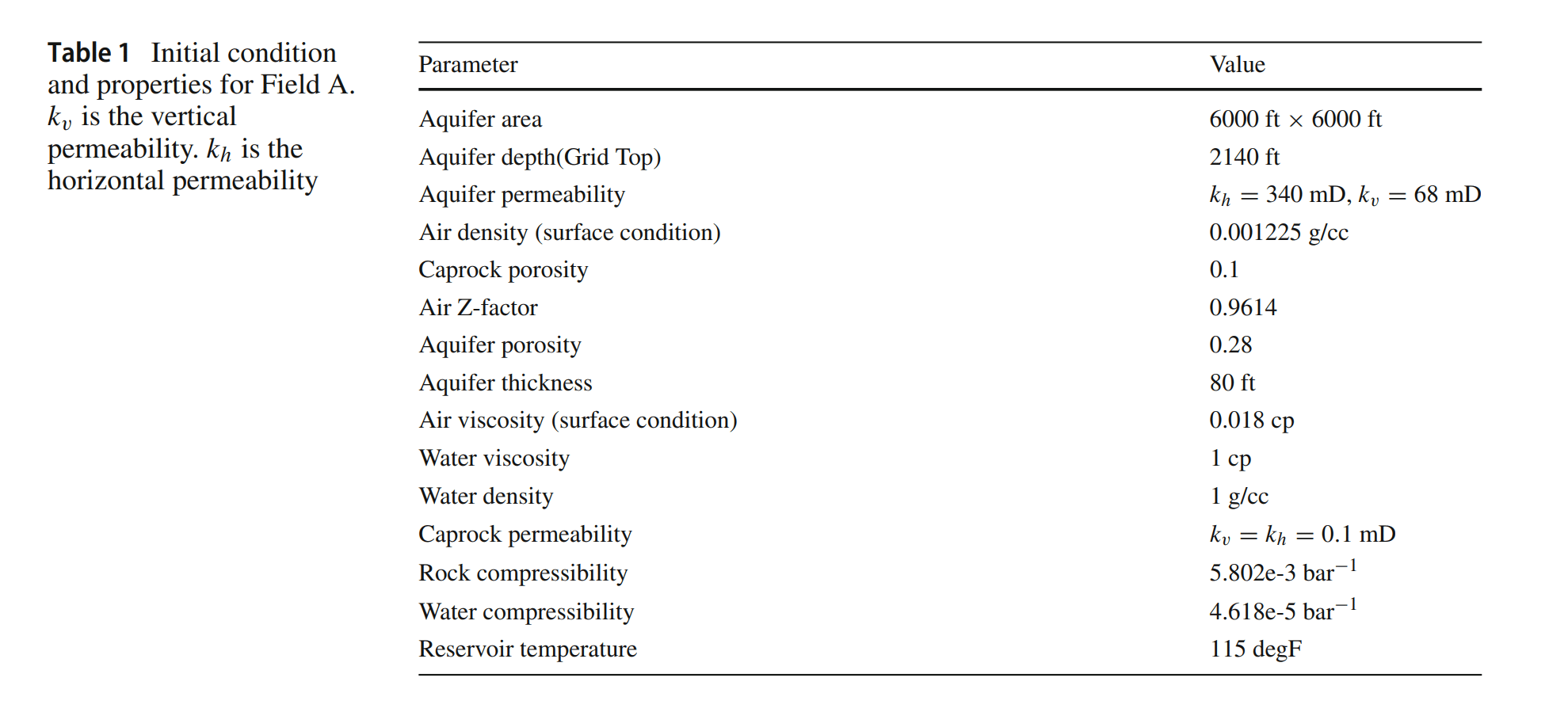
– 网格:6000 ft×6000 ft×180 ft,20–25 层,垂向局部加密至4 ft;单井最小网格2 m。
– 井控:定地面流量+井底压力上限(≤原始地层压力,防压裂)。
– 并行:8 核运算,540 d 模拟耗时≈4 h。所有结果(压力、饱和度、温度、centroid 轨迹)均通过 CMG 后处理提取并交叉验证。
主要结论
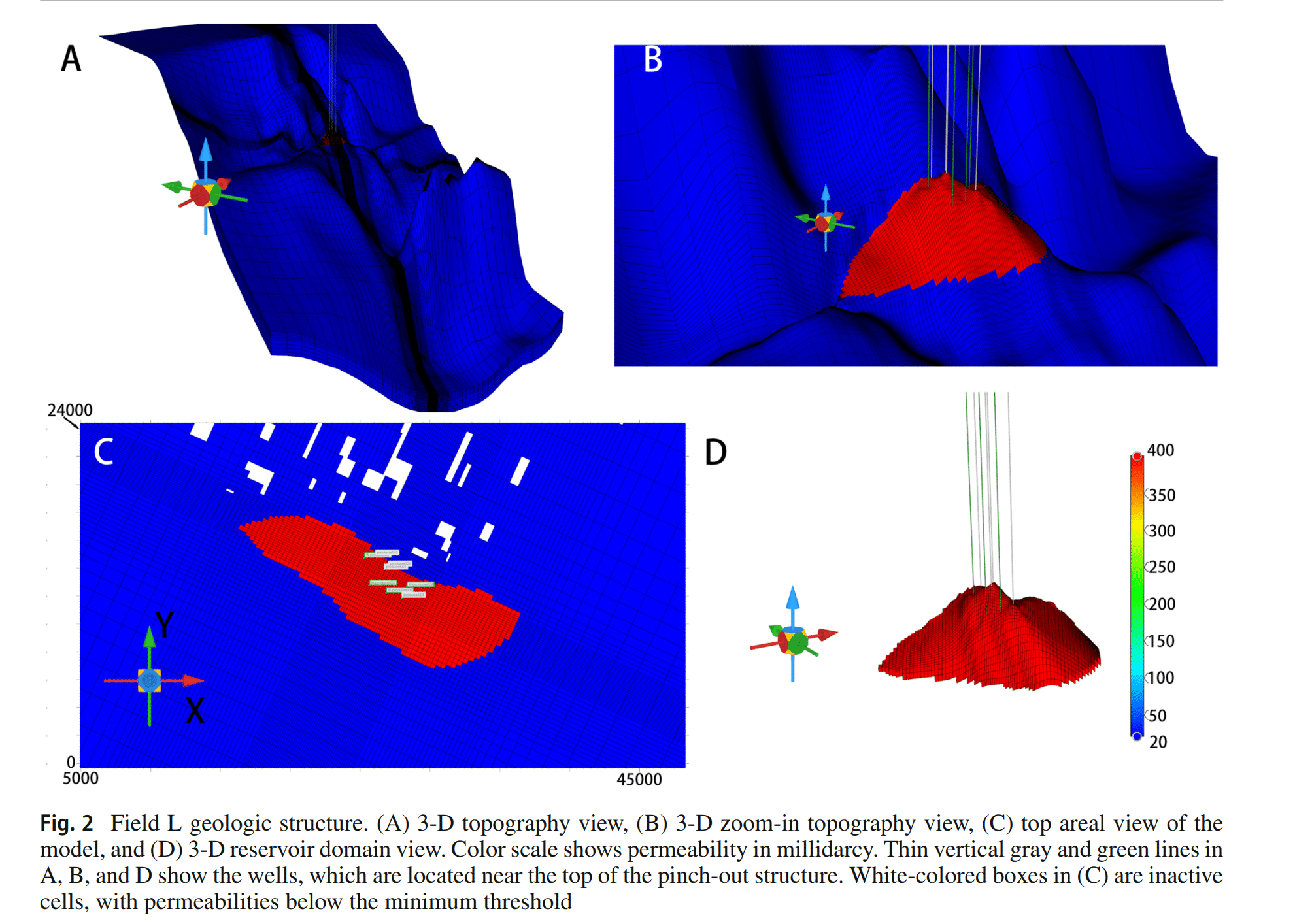
- 地质形态决定空气囊稳定性:穹隆与背斜构造利用顶部“气体帽”浮力锁定空气,18 个月循环后空气囊体积膨胀系数比水平层状高 1.2–1.4 倍,且几乎不产生水。
- 三步法作业普遍适用:衰竭-长大-日循环顺序可在 6 个月内建立稳定空气垫(体积≈总注气量 1/3),井底压力波动<±5 %,满足 5 MW 模块 350 ft³ min⁻¹(75 bar)连续采气要求。
- 渗透率各向异性(kv/kh≈0.2)与射孔层位是控制空气突破的关键:将注气层置于底、采气层置于顶,可延迟突破 10–20 d,并降低循环阶段产水量一个数量级。
- 产水经济评价:水平层状场地需额外处理 800 bbl/d 水,而穹隆场地<10 bbl/d,直接决定地面处理设施投资与环保成本。
- 模型局限与展望:目前为二维对称单元+单井模型,未来需扩展三维多井多周期,并耦合地质力学与盖层完整性评价。
作者单位
南加州大学(University of Southern California)地球科学与土木环境系
Abstract 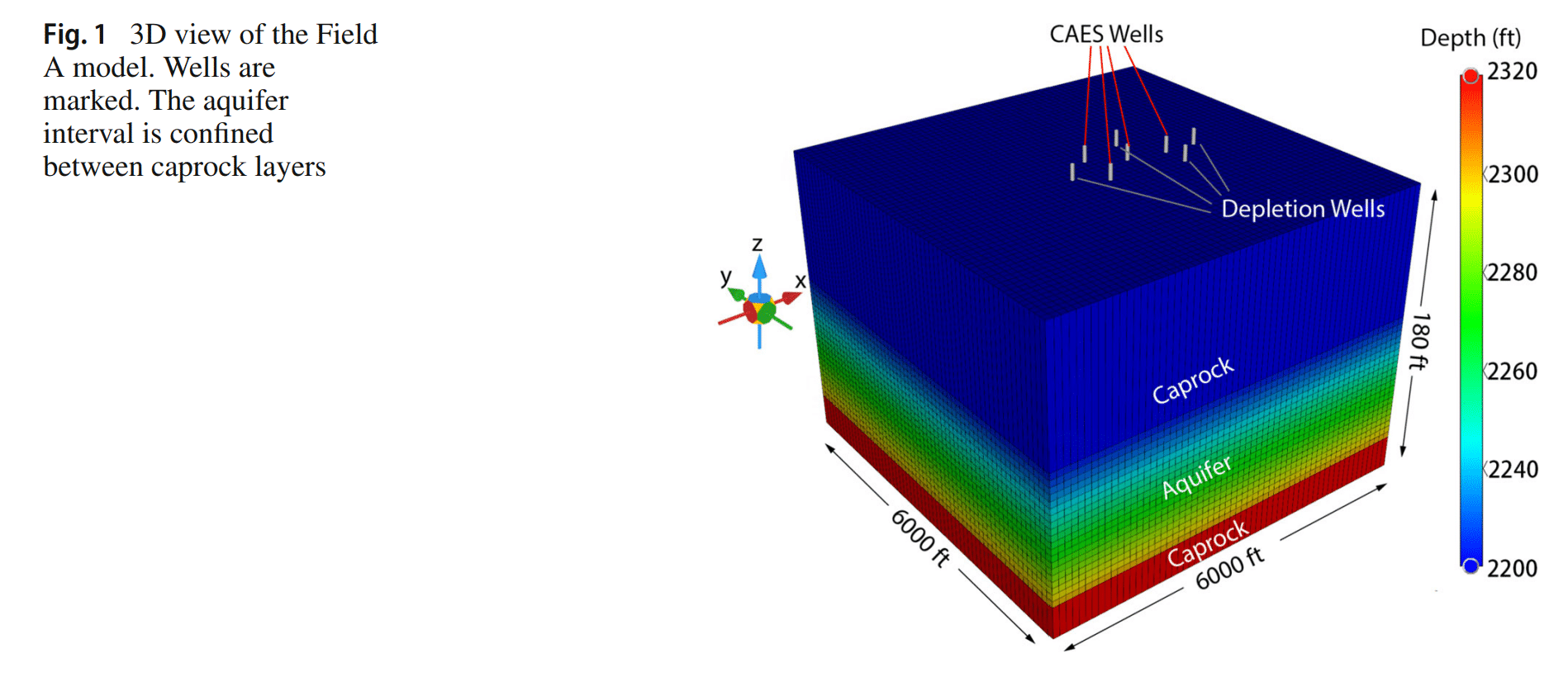
Abstract
Compressed Air Energy Storage (CAES) in aquifers is a promising technology for smoothing power fluctuations and intermittency associated with renewable sources such as wind and solar power. Excess energy from renewables can be stored in the form of compressed air in subsurface aquifers and produced later to meet demand, for example, by daily cycling of wells between day-time air injection and night-time air production. One of the challenges in adopting CAES is a lack of understanding about the stability and dynamics of the air pocket in terms of its size, shape, position, and pressure evolution, and how multiphase flow mechanisms and geologic structure affect the stability. The impact of vertical segregation of layers used for air production, air injection, and water extraction on growing the initial air pocket and maintaining the final air pocket is unknown. Here, we address the question of air pocket stability by constructing multiphysics models of CAES in realistic geologic structures with flat-layered, dome-shaped, and anticlinal aquifers. We propose and simulate a novel three-stage CAES process—aquifer depletion, air pocket growth, and daily cycling—to track the evolution of air pockets around wells, including the events of merger of individual pockets and breakthrough of air and water in wells. We quantify the impact of geologic structure and air-water mobility contrast on the pressure, size, and position of the air pockets. We quantify the dynamics of the produced water volume over the three stages as a function of the structure and multiphase flow behavior. Finally, we discuss the implications of air pocket stability and produced water dynamics for CAES site selection, operational cost, and risk.
