
Compositional Simulation of the Synergistic Impact of Impurities and Geochemical Reactions on the Efficiency of Impure CO₂ Sequestration at a Korean CCS Site
碳捕集与封存(CCS)是实现碳中和的重要技术路径,但实际CO₂气流中常含有H₂S、CH₄等杂质,这些杂质会改变CO₂的物理性质并影响储层中的地球化学反应,进而影响封存效率。本研究以韩国东海气田Gorae-V构造为地质模型,利用CMG-GEM组分模拟器,系统评估不同浓度(3.5%、10%、20%)H₂S和CH₄杂质对CO₂封存效果的影响。本研究强调,在CCS项目设计和封存效率评估中必须考虑杂质类型与浓度对物理-化学过程的协同影响。
CMG软件应用情况
- 使用软件:CMG-GEM(Compositional Simulator)
- 模拟内容:
- 多组分CO₂-H₂S-CH₄-盐水体系的流动与反应性传输;
- 采用Peng-Robinson状态方程(PR-EOS)描述流体相态;
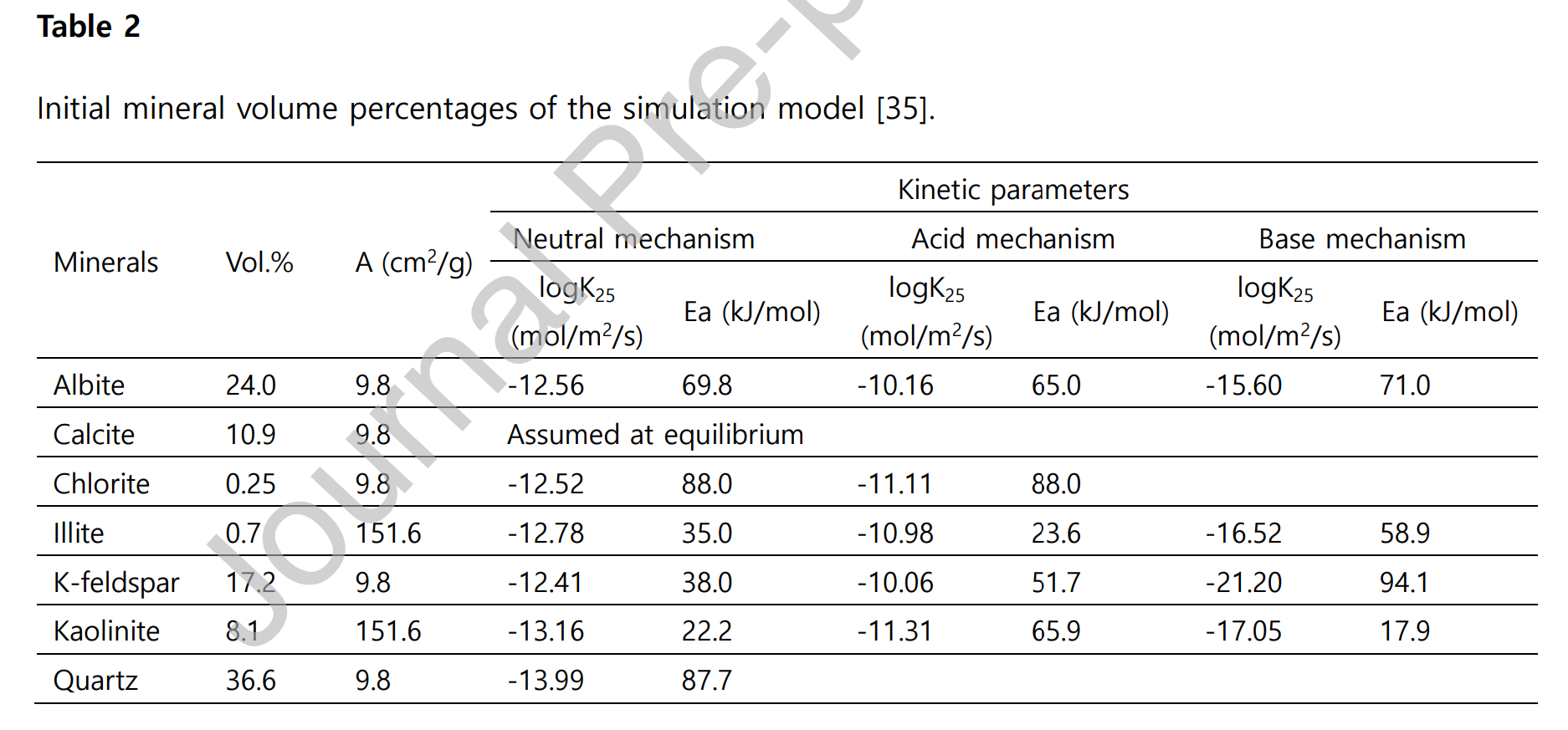
- 应用过渡态理论(TST)模拟矿物溶解/沉淀反应;
- 模拟时间:注入期10年 + 监测期100年;
- 模拟区域:85×85×10网格,共72,250个网格块;
- 模拟指标:CO₂封存效率、残余与溶解封存指数(RTI & STI)、孔隙体积变化、矿物反应速率等;
- 使用WinProp进行PVT性质拟合,结合Fick定律模拟扩散过程。
主要结论
- 杂质对CO₂物性影响显著:
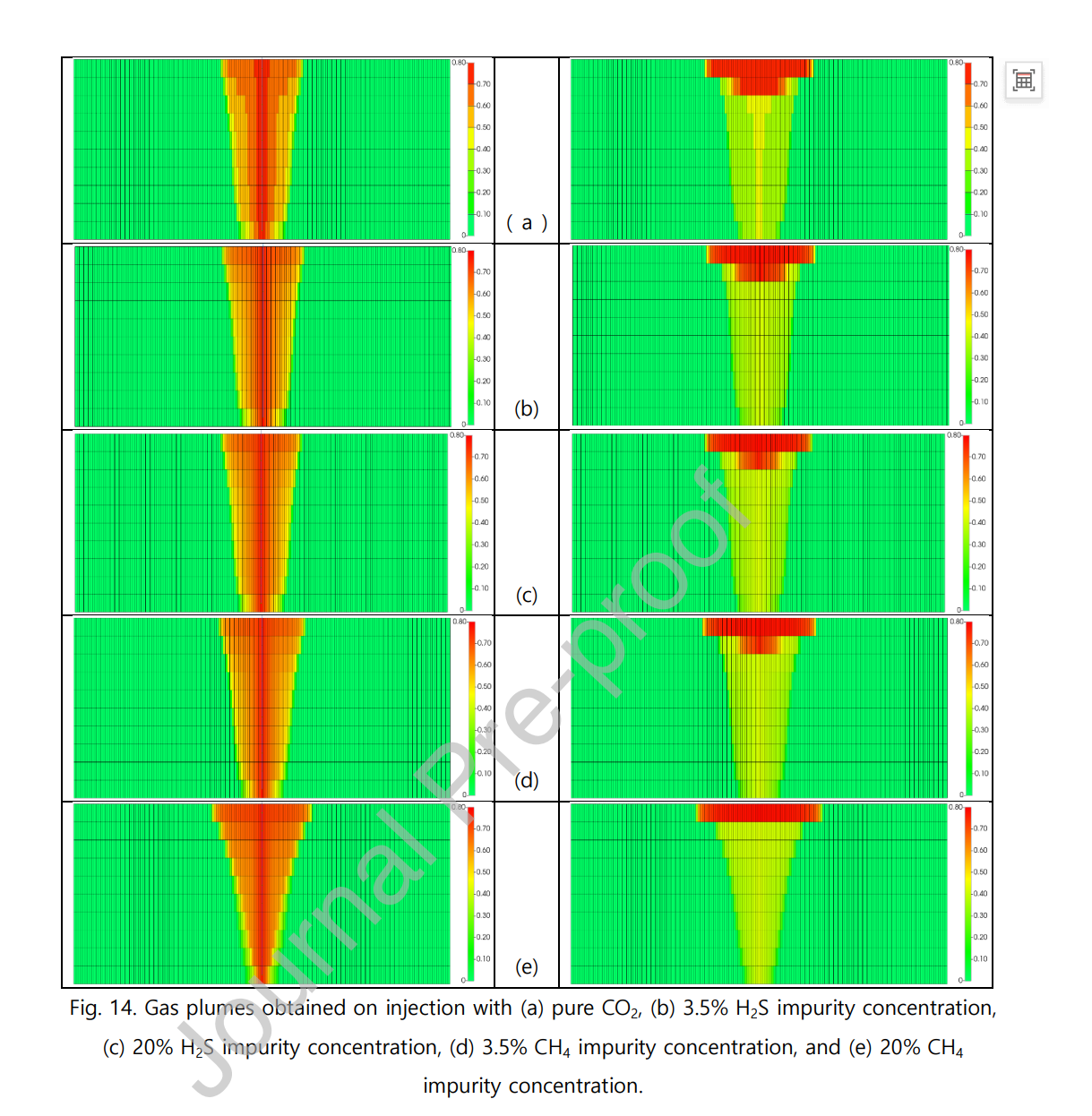
- CH₄降低密度(最多下降25.2%)和黏度,削弱残余封存;
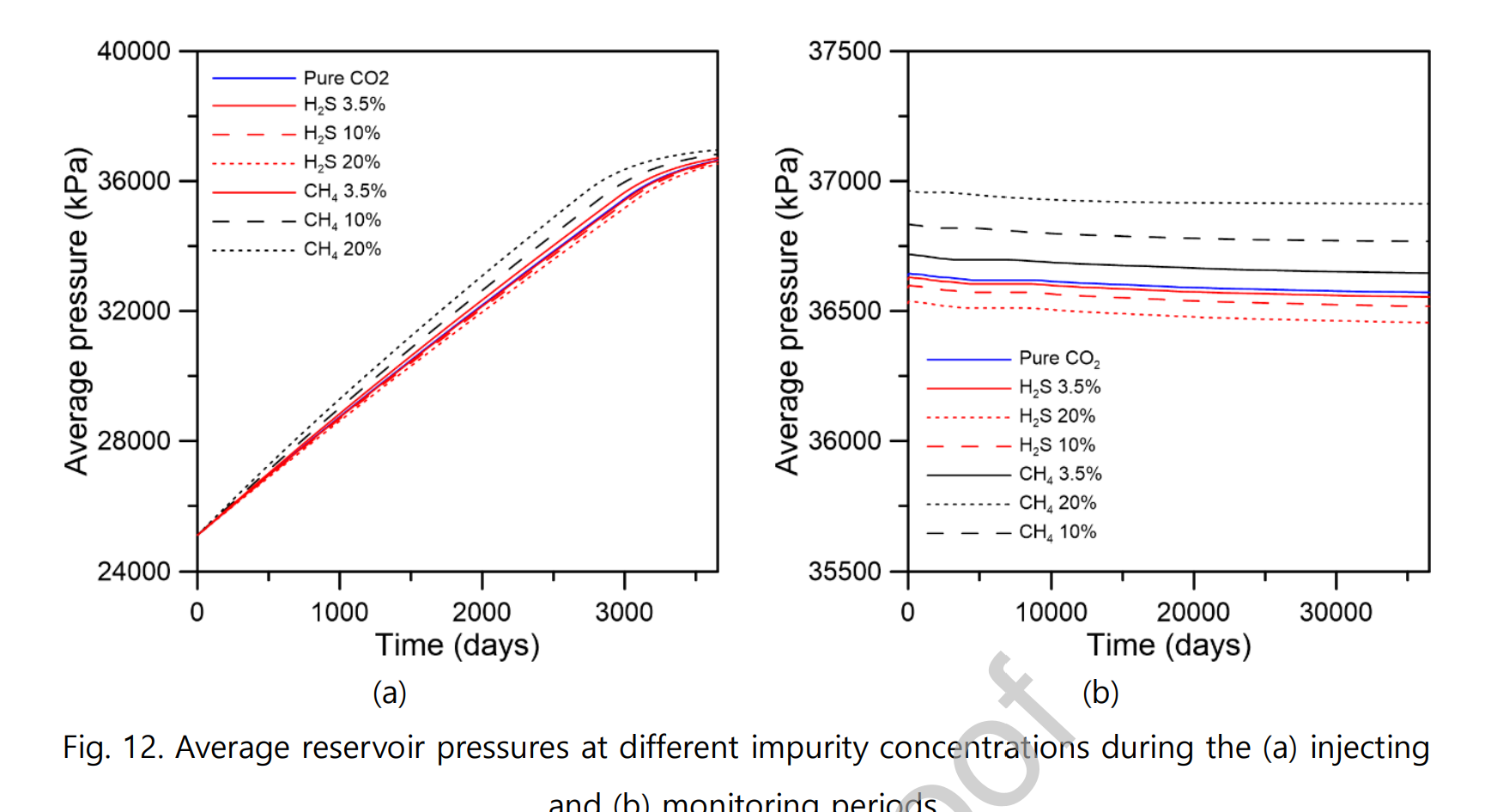
- H₂S提高密度和压缩性,延缓压力上升,有利于封存。
- 地球化学反应受杂质调控:
- CH₄增强硅酸盐矿物(如钠长石、钾长石)的溶解;
- H₂S促进碳酸盐矿物(如方解石)的溶解;
- 所有情景下孔隙体积变化小于1%,但矿物反应路径差异显著。
- 封存效率变化明显:
- 在20%杂质浓度下,CH₄使CO₂封存效率下降6.68%;
- 相同浓度下,H₂S使封存效率提升1.44%;
- 杂质类型和浓度显著影响RTI与STI,CH₄降低RTI约9%,H₂S略有提升。
- 实际意义:
- 含杂质CO₂注入对封存性能的影响主要由物理性质变化主导;
- 建议在CCS项目前期评估中必须进行含杂质组分的模拟分析;
- 后续研究需进一步考虑杂质对井筒腐蚀、盖层稳定性及次生矿物沉淀的影响。
作者单位
韩国江原大学氢能安全融合工程系
Abstract
Carbon capture and storage involves CO2 injection into geological structures to mitigate industrial CO2 emissions. CO2 capture processing can lead to inclusion of impurities such as H2S and CH4, which alter the properties of CO2, influencing geochemical reactions in reservoirs and CO2 storage efficiency. In this study, the impact of impurities and geochemical reactions on CO₂ storage efficiency was analyzed using reservoir simulation. The impurities altered the properties of CO₂ depending on both their type and concentration. CO2 mixture density decreased by up to 74.8% with 20% CH4 impurity. Also, the concentrations of aqueous hydrogen ions and metal ions varied compared to those in pure CO2 injection scenarios. As the results, geochemical reactions with CO₂ mixtures altered the pore volume by less than 1%. These findings indicate that impurities influence the gas storage capacity differently: H2S impurities increase the storage capacity, while CH4 impurities reduce it. The differences in CO2 storage capacity become more pronounced as the impurity concentrations rise. Specifically, at 20% impurity, H2S increased CO2 storage capacity by 1.44%, CH4 reduced it by 6.68%. Impurities modify CO2 properties, and the resulting decrease in CO2 density and volume percentage negatively affects the residual trapping efficiency, particularly when CH4 is included. Overall, these findings demonstrate that impure CO2 injection influences geochemical reactions and CO2 properties, with combined effects on storage efficiency in saline aquifers.
