Condensate-Banking Removal and Gas-Production Enhancement Using Thermochemical Injection: A Field-Scale Simulation
Abstract
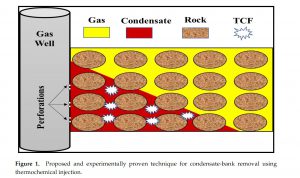
Condensate-liquid accumulation in the vicinity of a well is known to curtail gas production up to 80%. Numerous approaches are employed to mitigate condensate banking and improve gas productivity. In this work, a field-scale simulation is presented for condensate damage removal in tight reservoirs using a thermochemical treatment strategy where heat and pressure are generated in situ. The impact of thermochemical injection on the gas recovery is also elucidated. A compositional simulator was utilized to assess the effectiveness of the suggested treatment on reducing the condensate damage and, thereby, improve the gas recovery. Compared to the base case, represented by an industry-standard gas injection strategy, simulation studies suggest a significantly improved hydrocarbon recovery performance upon thermochemical treatment of the near-wellbore zone. For the scenarios investigated, the application of thermochemicals allowed for an extension of the production plateau from 104 days, as determined for the reference gas injection case, to 683 days. This represents a 6.5-fold increase in production plateau time, boosting gas recovery from 25 to 89%. The improved recovery is attributed to the reduction of both capillary pressure and condensate viscosity. The presented work is crucial for designing and implementing thermochemical treatments in tight-gas reservoirs.
Keywords: tight reservoirs; gas recovery; thermochemical treatment; field-scale simulation