
Integrating CO2 sequestration and enhanced gas recovery: a comprehensive evaluation for sustainable carbon management
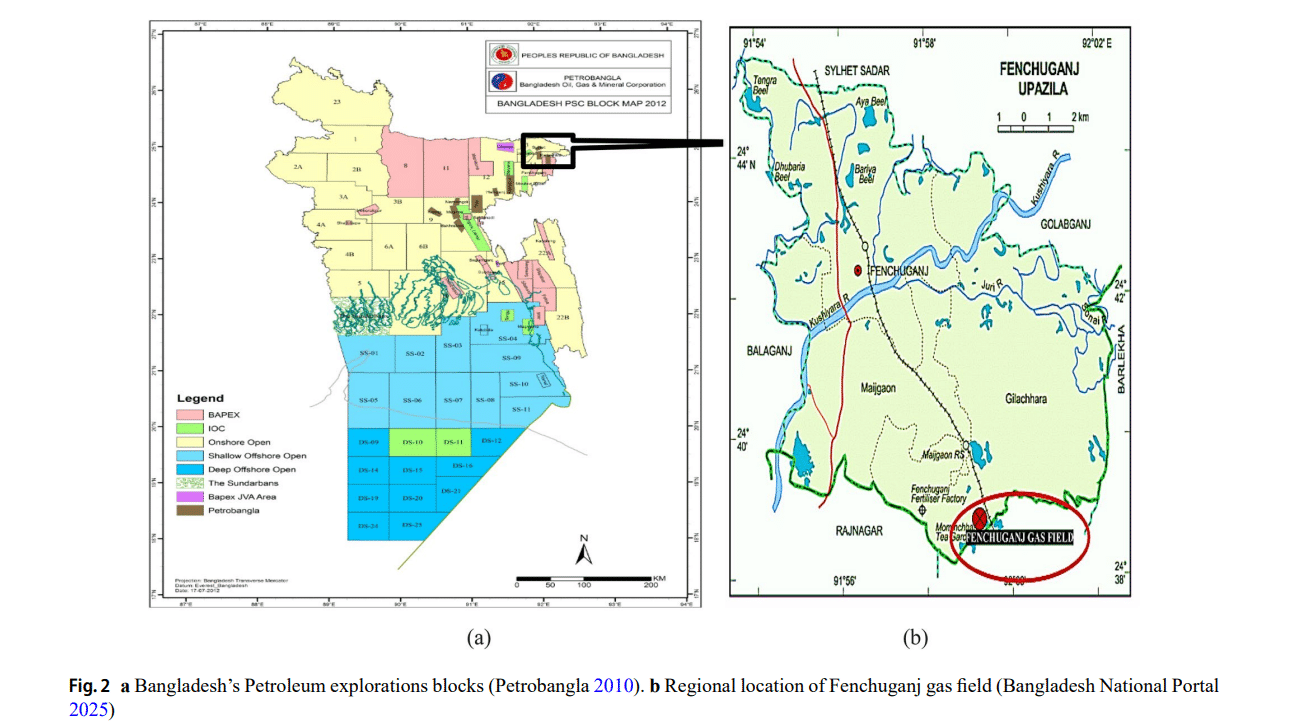
在孟加拉国,2000年至2020年间CO₂排放量增长了40%,主要来源于电力与工业部门。为应对这一挑战,本文提出将CO₂封存与提高天然气采收率(CO₂-EGR)相结合的策略,利用CMG软件对孟加拉国Fenchuganj气田进行三维油藏数值模拟,评估其在枯竭气藏中同时实现CO₂封存与甲烷回采的可行性。通过敏感性分析优化注入井井位、注入速度与注入压力,最终确定交错井网+47 MMSCF/D注入速率+4700 psi注入压力为最佳方案,获得4.52%的天然气采收率与1.36×10¹² ft³的CO₂封存量。研究表明,该方法不仅能有效提高天然气采收率,还能封存相当于孟加拉国年排放量1.24%的CO₂,具有良好的环境与经济效益。
CMG软件应用情况:
- 使用CMG Builder构建三维油藏模型,CMG STARS进行动态模拟。
- 模拟CO₂注入过程中的多相流动、组分变化、混相行为及地质化学反应。
- 评估不同井网布置、注入压力与速率对采收率和封存效率的影响。
- 模拟CO₂突破时间、储层压力变化、气体质量下降及封存机制(构造、残余、溶解、矿化)演化过程。
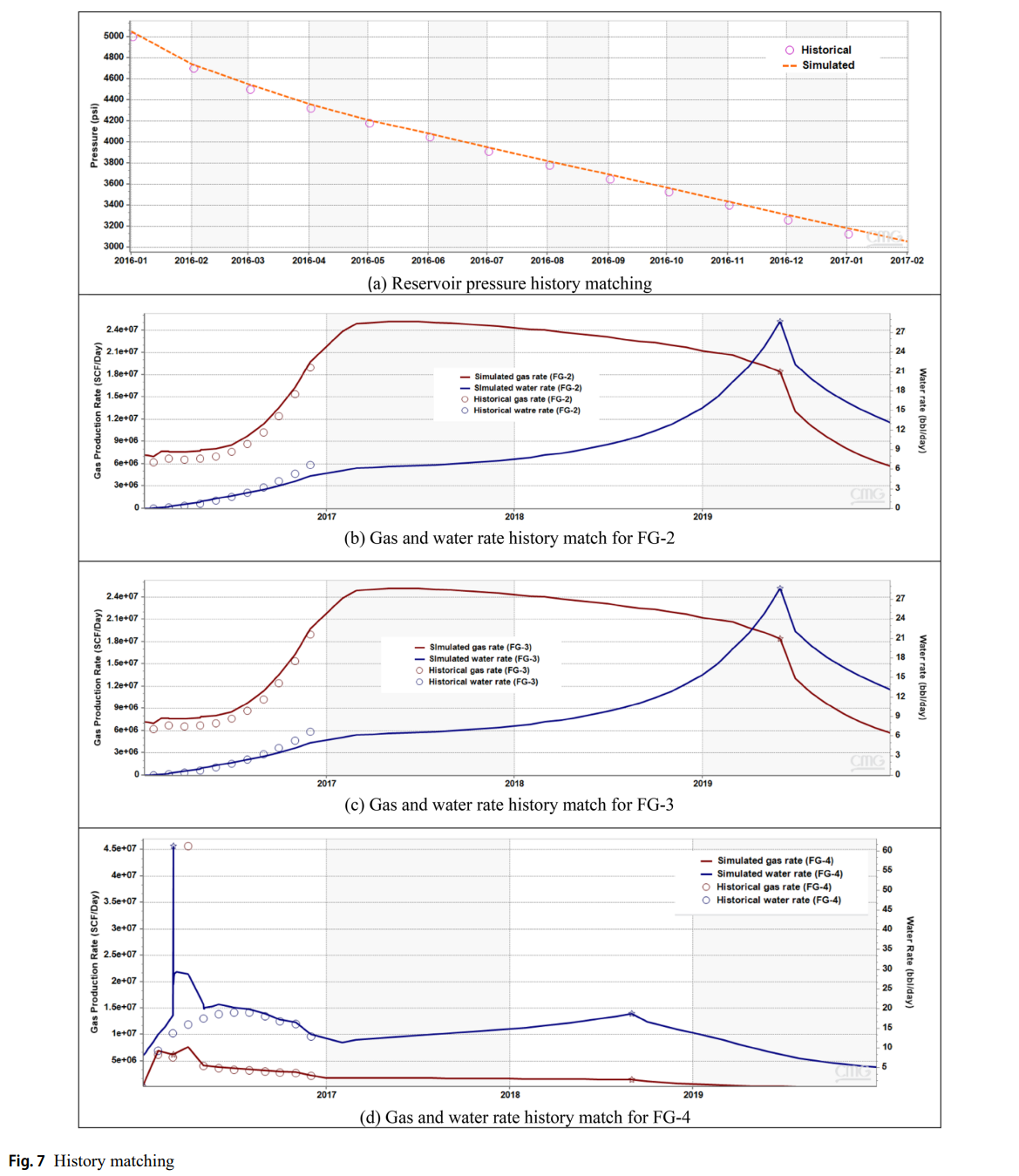
- 进行历史拟合验证模型可靠性,确保预测结果准确。
结论:
- 交错井网+47 MMSCF/D注入速度+4700 psi注入压力为最优方案,采收率达4.52%,CO₂封存量达1.36×10¹² ft³。
- CO₂在FG-3、FG-2、FG-4三口井依次突破,突破时间受井位与渗透率影响显著。
- CO₂封存以构造封存为主(64.2%),其次为溶解封存(27.4%)与残余封存(8.4%)。
- 长期注入会导致产出气体热值下降,需配套气体分离与CO₂回注技术。
- 储层完整性良好,注入压力低于破裂压力(6005 psi),无泄漏风险。
- 本研究为孟加拉国实现碳中和目标提供了技术路径,适用于其他枯竭气田的CCUS项目。
作者单位:
孟加拉国吉大港工程技术大学(Chittagong University of Engineering and Technology)石油与矿业工程系

Abstract
Greenhouse gases pose a significant threat to life on Earth by trapping infrared radiation, leading to global warming. In Bangladesh, carbon dioxide (CO2) emissions have surged by 40% from 2000 to 2020, primarily from the power industry and process sector, making CO2 the most significant contributor to the country’s greenhouse gas inventory. One promising mitigation strategy is the integration of CO2 sequestration with enhanced gas recovery (CO2-EGR-CCUS) in depleted gas reservoirs. This study presents a reservoir simulation-based investigation using CMG software to evaluate the dual objective of maximizing CO2 storage and recovering residual methane. A comprehensive sensitivity analysis was also performed to assess the impact of well placement, injection rate, and injection pressure on CO2 injectivity and methane recovery. Among the tested scenarios, staggered well placement with an injection rate of 47 MMSCF/D at 4700 psi yielded the highest gas recovery factor of 4.52%, recovering 1.3 BCF of methane from a depleted gas reservoir with a Gas Initially in Place of 28.8 BCF. The abandoned gas rate was 0.1 × 10⁶ SCF/day, and residual gas saturation was 0.1. The cumulative CO2 injection reached 3.82 × 10¹² SCF, with 1.36 × 10¹² SCF securely stored under a fracture pressure limit of 6000 psi, as determined using the Pennebaker Correlation. Notably, the project demonstrates a CO2 capture potential equivalent to 1.24% of Bangladesh’s total annual CO2 emissions. Staggered well placement also achieved the highest sweep efficiency (12.27%), outperforming linear and five-spot patterns by 3.19% and 2.41%, respectively. These findings highlight the feasibility of combining CO2 storage with enhanced methane recovery as a scalable and sustainable strategy for carbon management in Bangladesh. The study contributes valuable insights into optimizing CCUS operations under site-specific geological and operational constraints.
