
Analysis of downhole temperature-strain response in hydraulic fracturing – A coupled geomechanics-thermal-flow simulation approach
本文提出了一种基于商业软件(CMG)的耦合地质力学-热-流动模拟方法,用于分析水力压裂过程中的温度与应变响应。研究聚焦光纤技术(如分布式温度传感DTS和低频分布式声学传感LF-DAS)在裂缝实时监测中的应用,通过三维可变形有限元地质力学模型和双孔隙双渗透率(DPDK)流动-热模拟,结合动态节点开裂技术模拟水力裂缝的扩展。模型验证了裂缝几何形态、注入压力、温度及应变响应,并与KGD/PKN模型、渐近解析解及现场LF-DAS数据对比。研究发现,温度变化引起的热应力是LF-DAS光学相位偏移现象的重要机制,为光纤数据解释提供了新视角。
CMG软件解决方案
- 耦合模拟框架
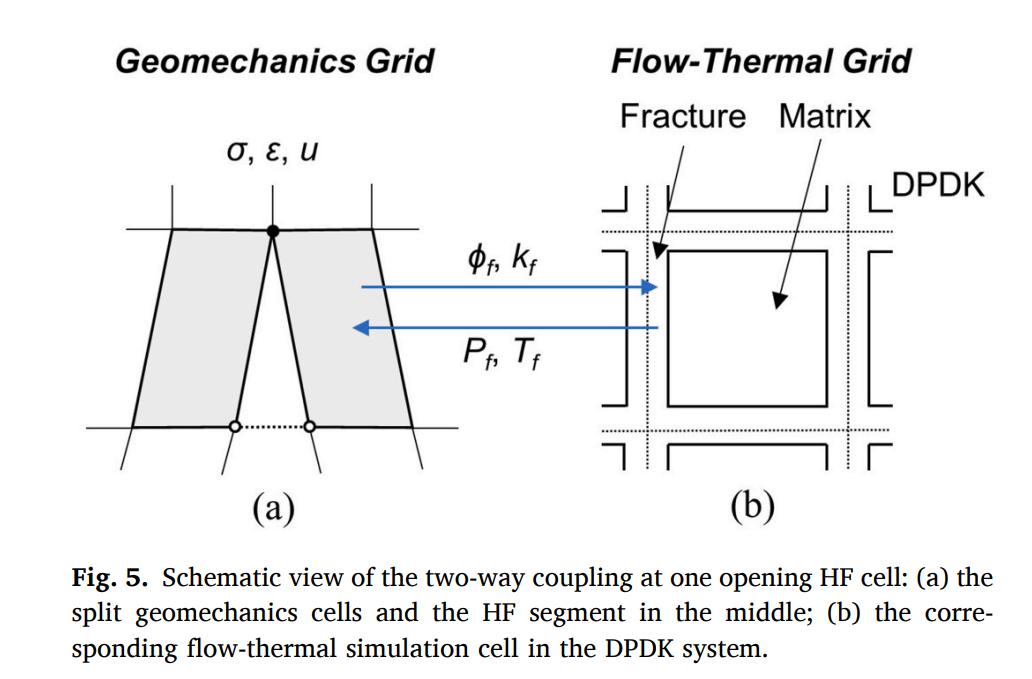
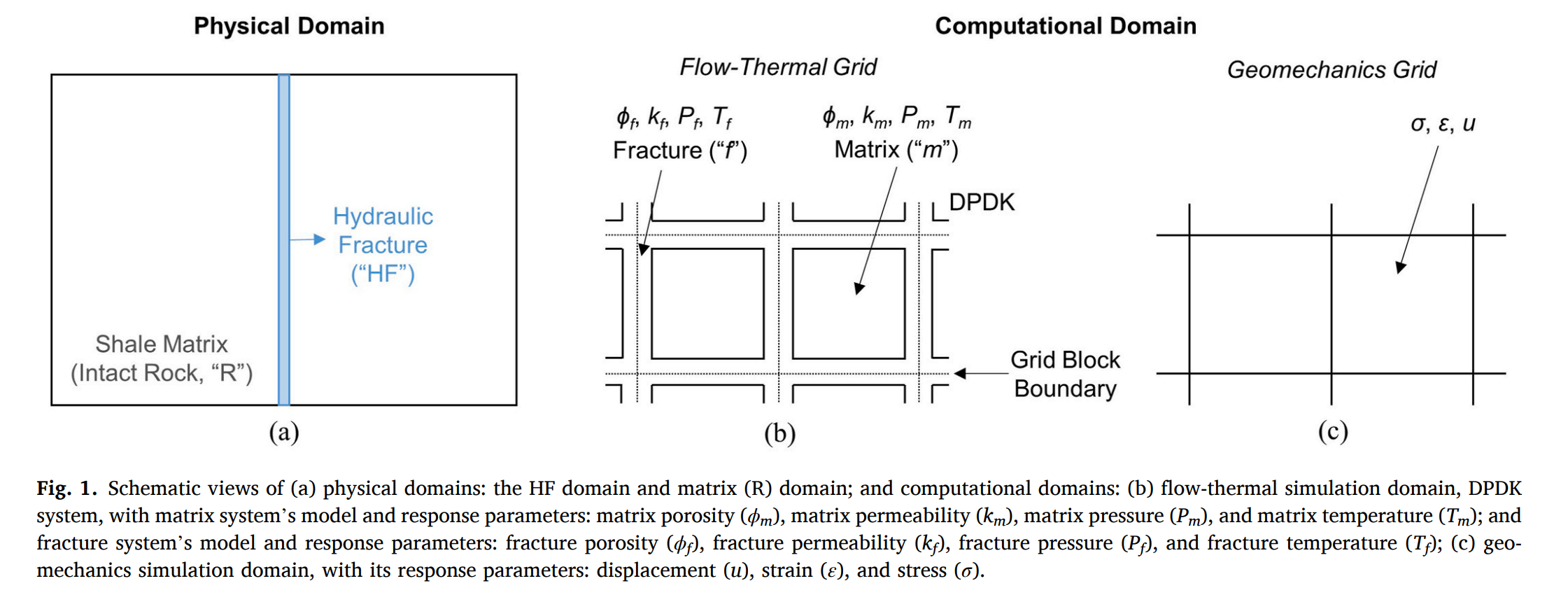
- 流动-热模块:使用CMG的IMEX(黑油模拟器)和STARS(热采模拟器)进行双孔隙双渗透率(DPDK)模拟,分别描述基质与裂缝系统的流体流动、热传导及对流过程。
- 地质力学模块:采用三维有限元模型,通过动态节点开裂技术模拟裂缝扩展,计算位移、应变及应力场。
- 双向耦合:流动-热模型与地质力学模型通过孔隙度更新(基于压力、温度及平均应力)实现数据交互,确保力学变形与流体流动的实时反馈。
- 关键技术
- 动态节点开裂:预定义裂缝扩展路径,当拉应力超过临界值时开裂节点模拟裂缝张开。
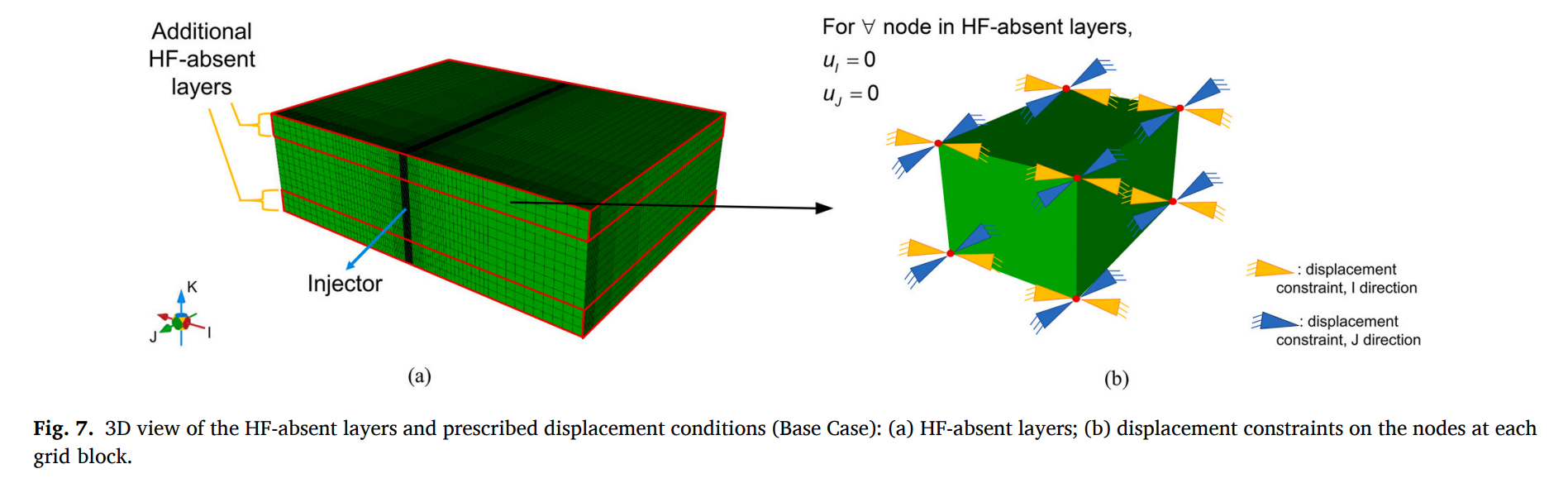
- 边界条件优化:通过设置无裂缝层(HF-absent layers)约束位移,避免边界效应干扰。
- 网格离散化策略:在裂缝路径附近进行局部网格加密,平衡计算效率与精度。
模拟结果
- 验证对比
- 裂缝几何与压力:与KGD/PKN模型及渐近解析解(韧性主导区)对比,裂缝长度、宽度及净注入压力趋势一致,验证模型可靠性。
- 温度响应:与简化解析解对比,模拟结果捕捉了压裂液冷却效应及基质热传导特征,但解析解因忽略漏失而高估温度恢复速度。
- 应变场分析:与Liu等(2020)数值解对比,位移、应变及应变率瀑布图特征吻合,成功复现压窜(frac hit)前后的压缩-拉伸信号。
- 现场数据关联
- LF-DAS相位偏移:模拟应变率瀑布图与蒙大拿组现场数据定性一致,揭示了温度梯度突变与裂缝间歇性扩展(“粘滑”效应)对光学相位偏移的影响机制。
结论
- 提出的耦合建模策略有效整合了CMG软件的多物理场模拟能力,为水力压裂过程的光纤监测数据解释提供了可靠工具。
- 温度变化通过热应力影响岩石应变,是LF-DAS相位偏移现象的关键诱因,需在数据分析中综合考虑热-力学耦合效应。
- 模型验证表明,商业软件在复杂裂缝扩展模拟中具备高精度潜力,适用于页岩气、致密储层及增强地热系统(EGS)等场景。



Highlights
- Mechanistic coupled geomechanical-thermal-flow simulations of hydraulic fracturing are presented.
- Novel strategies for constructing the simulations using commercial packages are detailed.
- The model responses are thoroughly validated and correlated with field LF-DAS data.
- The mechanisms of optical-phase-shifting phenomena in the LF-DAS plots are studied.
- The thermal effects of hydraulic fracturing and fibre optic data signal complexity are studied.
Abstract
Fiber optic technologies are important real-time fracture diagnostics and monitoring tools. Simulating field temperature and strain responses using a coupled geomechanical-thermal-flow simulation approach remains challenging, even with the use of commercial software packages. This study presents a novel comprehensive modelling strategy for constructing coupled flow-geomechanical-thermal simulations to analyze fracturing processes in subsurface flow applications. This paper is the first study that meticulously examines different model set-up options, illustrating how commercial packages can be utilized in this context. A 3D deformable finite-element geomechanics system and dual-porosity-dual-permeability flow and thermal simulations are conducted. A dynamic node-splitting technique facilitates the modelling of hydraulic fracture (HF) opening and propagation. The model responses—including fracture geometry, injection pressure, and temperature—are thoroughly validated against several analytical solutions. Geomechanical responses such as displacement, strain, and strain rate are validated against a well-established numerical solution. Our model responses of strain-rate characteristics are compared to field Low-Frequency Distributed Acoustic Sensing (LF-DAS) data. A qualitative analysis has been conducted to explain the possible mechanisms behind the commonly observed optical phase-shifting phenomena in LF-DAS plots. Given that fluid injection and fracturing are commonly encountered in a wide range of geo-energy applications, the work presented in this study offers valuable insights into analyzing these processes and designing fiber-optic monitoring tools.
作者单位
加拿大阿尔伯塔大学土木与环境工程系
