
Geological–Engineering Synergistic Optimization of CO2 Flooding Well Patterns for Sweet Spot Development in Tight Oil Reservoirs
为在“双碳”目标下同时实现致密油藏提高采收率(EOR)与CO₂封存,本文构建了一套“地质-工程”一体化优化框架:
- 建立考虑启动压力梯度、混溶/非混溶两相流的半解析模型,动态校正注入强度;
- 提出“有效驱动系数”指标(可动用面积/井网控制面积),综合储层非均质性、裂缝方位(NE76.3°)确定井网下限;
- 通过CMG数值模拟验证,给出目标区块A(0.39 t/d/m)、B(0.63 t/d/m)最优注入强度及井距:反五点井网240 m(A)/260 m(B);
- 现场15年预测显示,该方案单井增油3621.6–4213.1 t,气窜风险下降35–47%。
研究为低渗致密油藏CO₂驱井网优化提供了可复制、可推广的技术路径。
【CMG软件应用情况】
• 软件:CMG2021
• 功能:
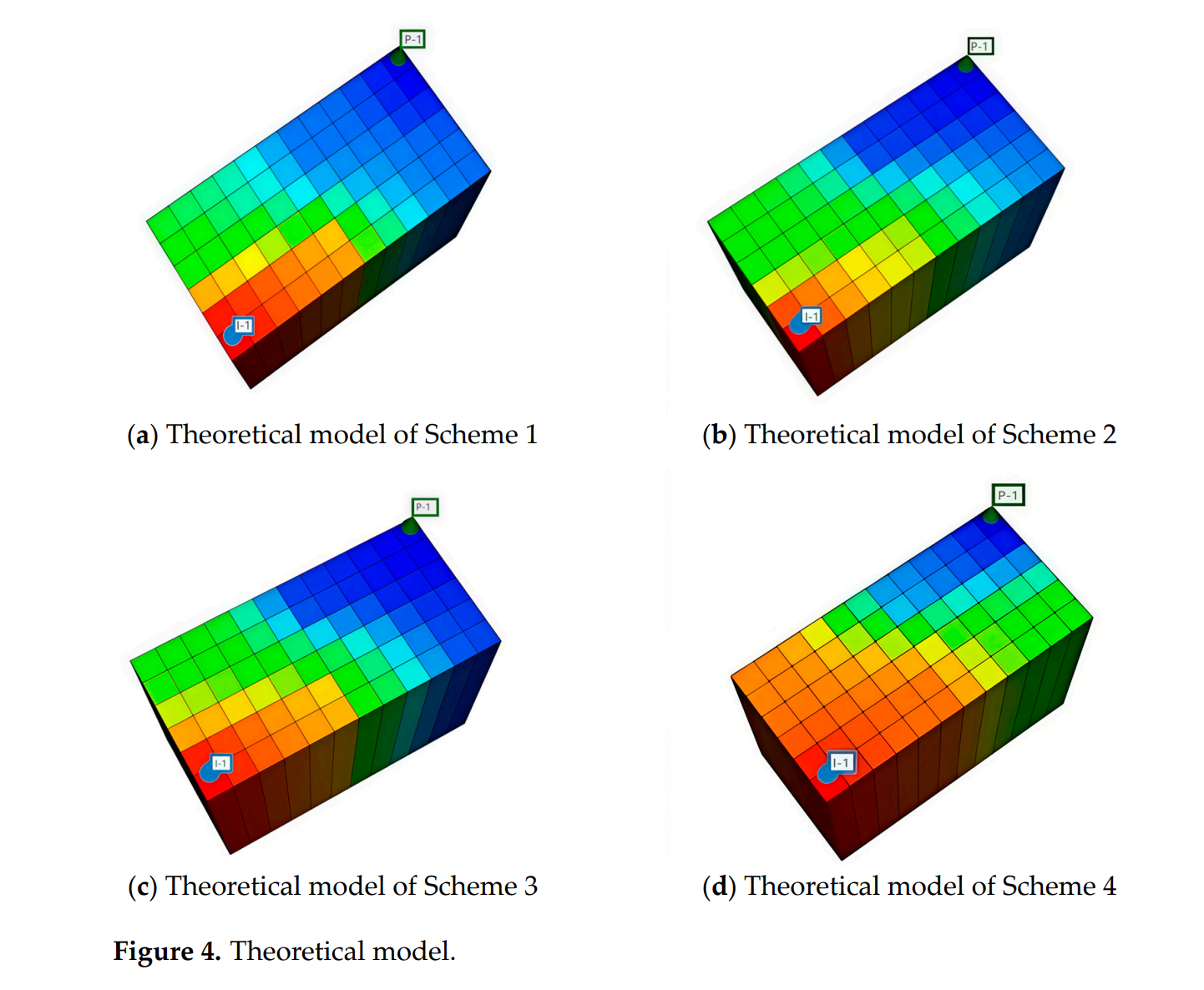
– 建立A、B两块三维地质模型(20 m×20 m网格,181×216 与 277×372 网格数);
– 利用CMG自带历史拟合模块,产油误差<5%,地层压力误差<4%;
– 调用CMG水力压裂模块输入现场施工数据,设置裂缝半长150 m、方位NE76.3°;
– 开展不同井网加密、沉积相组合、注水/注气参数敏感性及15年开发预测。
【主要结论】
- 反五点井网与裂缝方向一致时,有效驱动系数最大,为致密油藏CO₂驱最优井型;
- 井距下限:A块240 m(η=0.72)、B块260 m(η=0.87),再加密收益递减;
- 渗透率与启动压力梯度是影响注入强度与驱动系数的主控因素,蒙特卡罗95%置信区间已给出;
- 现场应用表明,优化后井网单井增油3000 t以上,气窜风险显著降低,验证了方法有效性。
【作者单位】
东北石油大学提高油气采收率教育部重点实验室
Abstract
CO2 flooding technology has been established as a key technique that is both economically viable and environmentally sustainable, achieving enhanced oil recovery (EOR) while advancing CCUS objectives. This study addresses the challenge of optimizing CO2 flooding well patterns in tight oil reservoirs through a geological–engineering integrated approach. A semi-analytical model incorporating startup pressure gradients and miscible/immiscible two-phase flow was developed to dynamically adjust injection intensity. An effective driving coefficient model considering reservoir heterogeneity and fracture orientation was proposed to determine well pattern boundaries. Field data from Blocks A and B were used to validate the models, with the results indicating optimal injection intensities of 0.39 t/d/m and 0.63 t/d/m, respectively. Numerical simulations confirmed that inverted five-spot patterns with well spacings of 240 m (Block A) and 260 m (Block B) achieved the highest incremental oil production (3621.6 t/well and 4213.1 t/well) while reducing the gas channeling risk by 35–47%. The proposed methodology provides a robust framework for enhancing recovery efficiency in low-permeability reservoirs under varying geological conditions.
