
Prediction/Assessment of CO2 EOR and Storage Efficiency in Residual Oil Zones Using Machine Learning Techniques
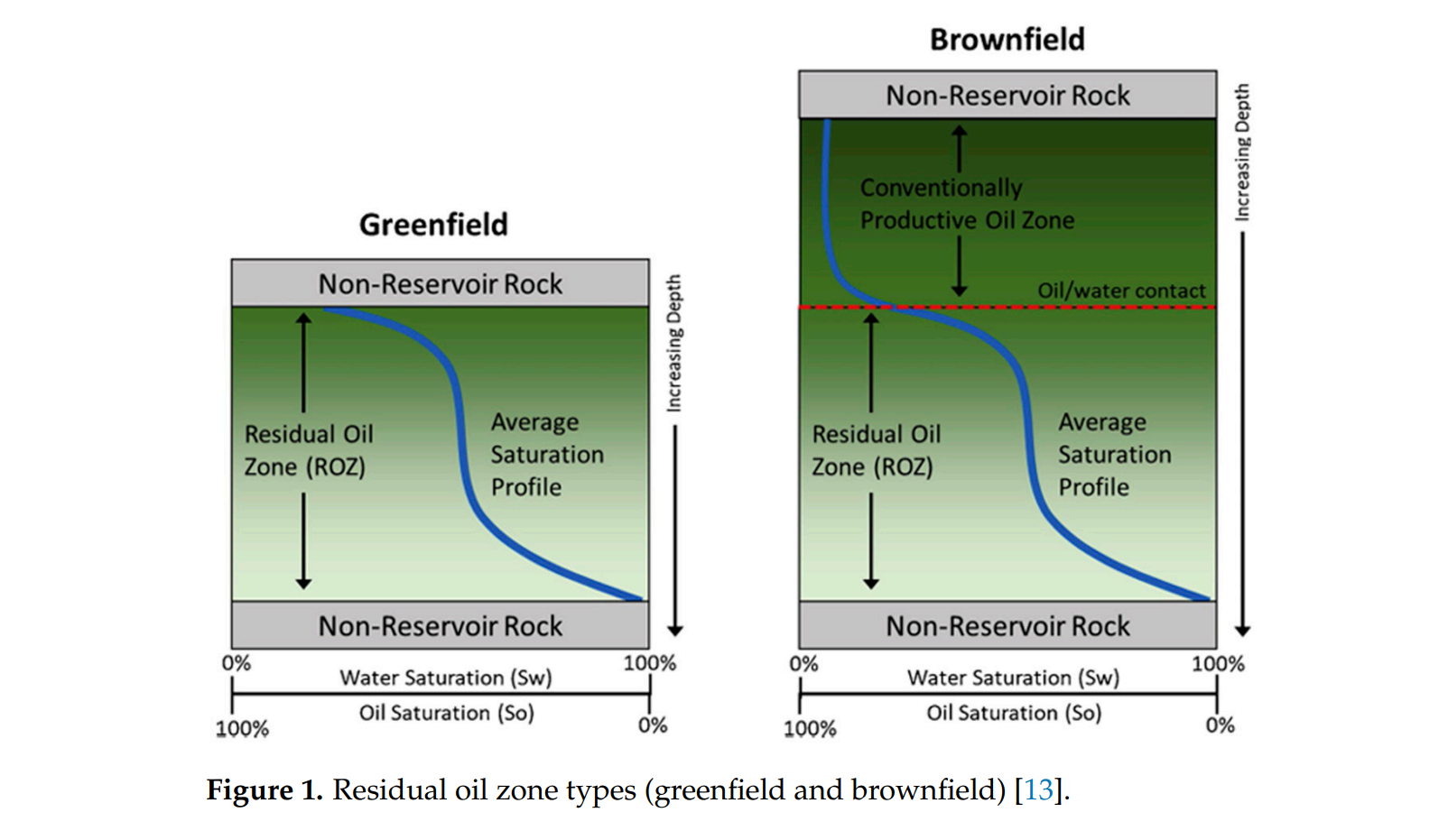
残余油带(ROZ)位于传统油藏油水界面以下,含有不可动油,过去被认为不具经济开发价值。然而,ROZ具备良好的CO₂封存潜力,并可作为CO₂驱油(EOR)与碳捕集、利用与封存(CCUS)的新目标区域。
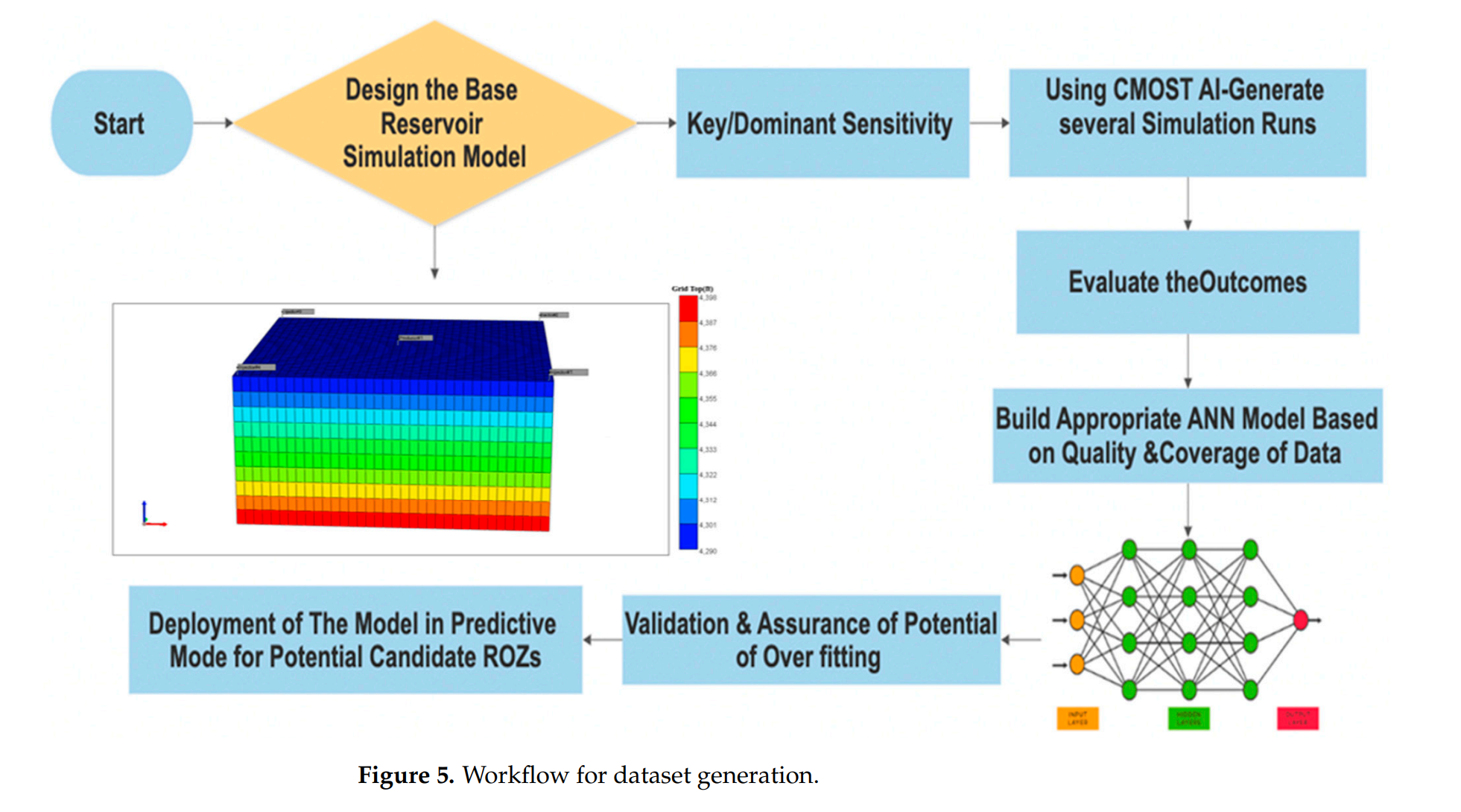
本文基于CMG GEM数值模拟平台,构建了300组ROZ模型,采用拉丁超立方采样(LHS)方法生成涵盖地质与工程参数的数据集,结合人工神经网络(ANN)建立快速预测模型,用于评估CO₂驱油与封存效率。模型预测精度高,R²达0.90~0.98,平均绝对百分比误差(MAPRE)低于10%。研究还识别出最优操作条件:生产井底流压约1250 psi、CO₂注入速率14–16 MMSCF/D,可实现采收率与封存效率的最佳平衡。该方法为ROZ区域的CO₂-EOR与CCUS快速筛选与优化提供了高效、可靠的技术手段。
CMG软件应用情况
- 软件平台:CMG GEM(2021版)
- 模拟内容:
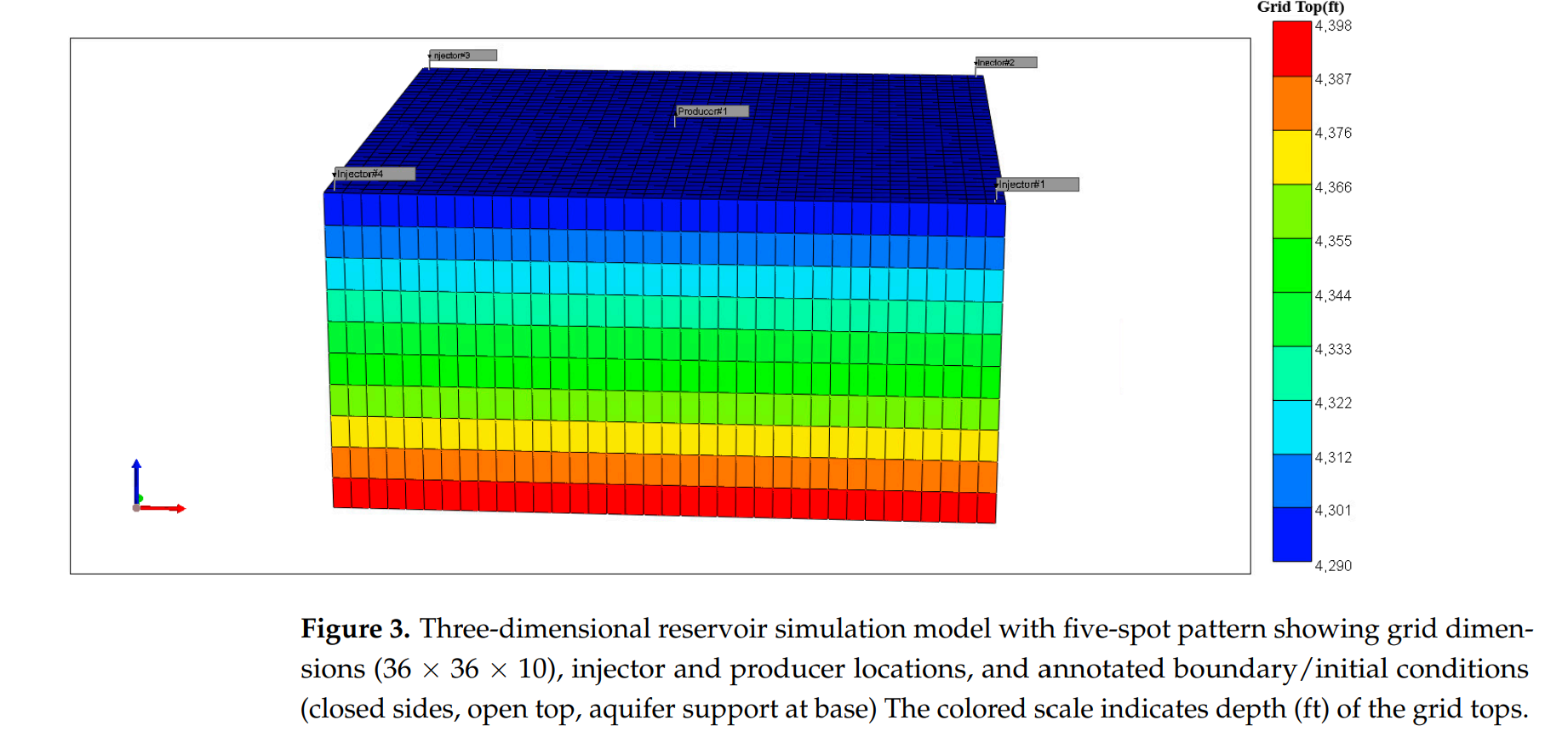
- 构建三维组分模型(36×36×10网格),模拟ROZ中CO₂驱油与封存过程;
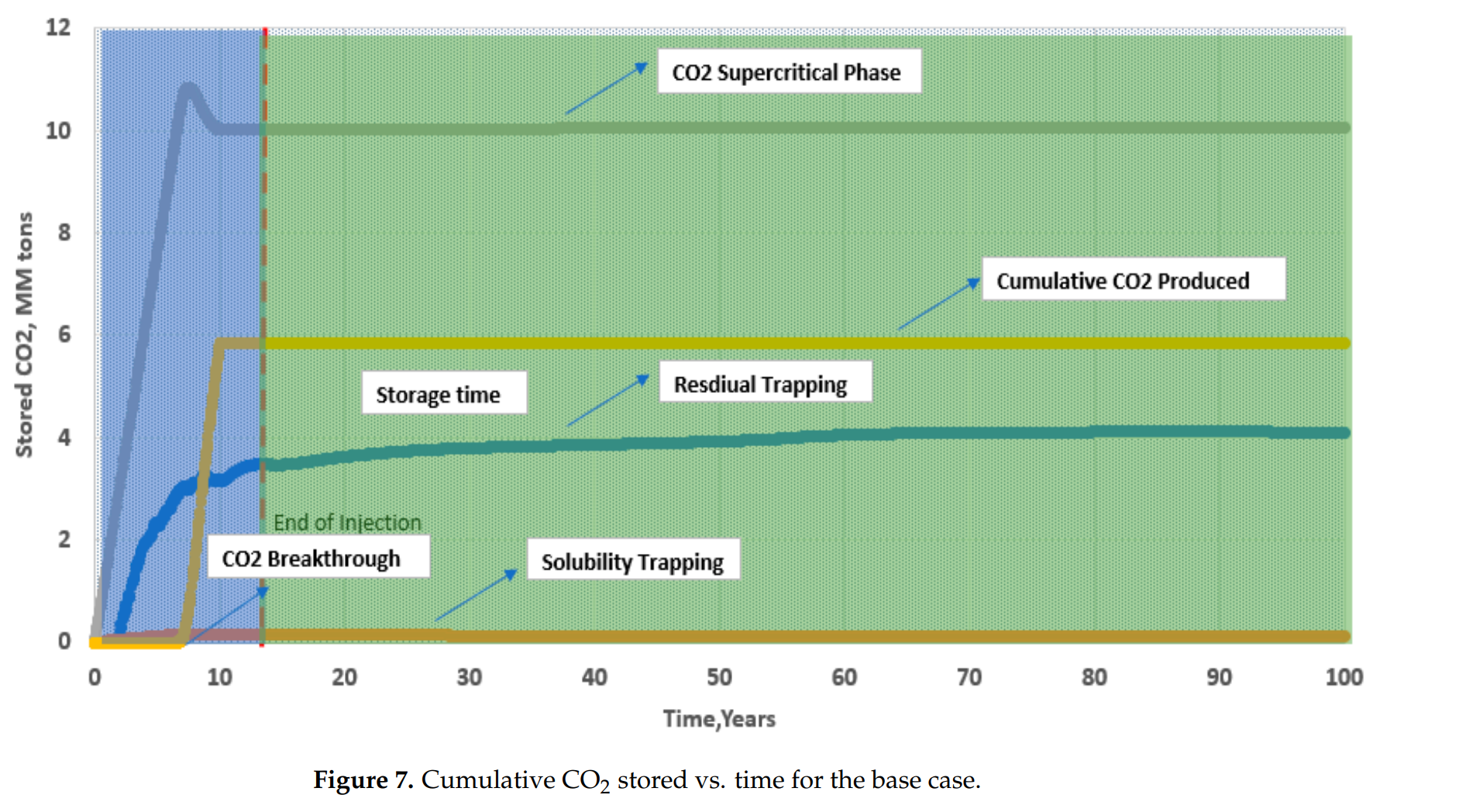
- 采用五点井网,模拟10年注入+90年封存期的全过程;
- 模拟CO₂在油、水、气三相中的运移与封存机制(构造封存、残余封存、溶解封存);
- 生成300组模拟案例,涵盖9个地质与工程参数(如渗透率、孔隙度、厚度、注入速率、井底压力等);
- 输出包括累积产油量、CO₂溶解量、残余与结构封存量等关键指标,用于训练ANN模型;
- 使用CMOST AI辅助生成样本与优化参数组合。
结论
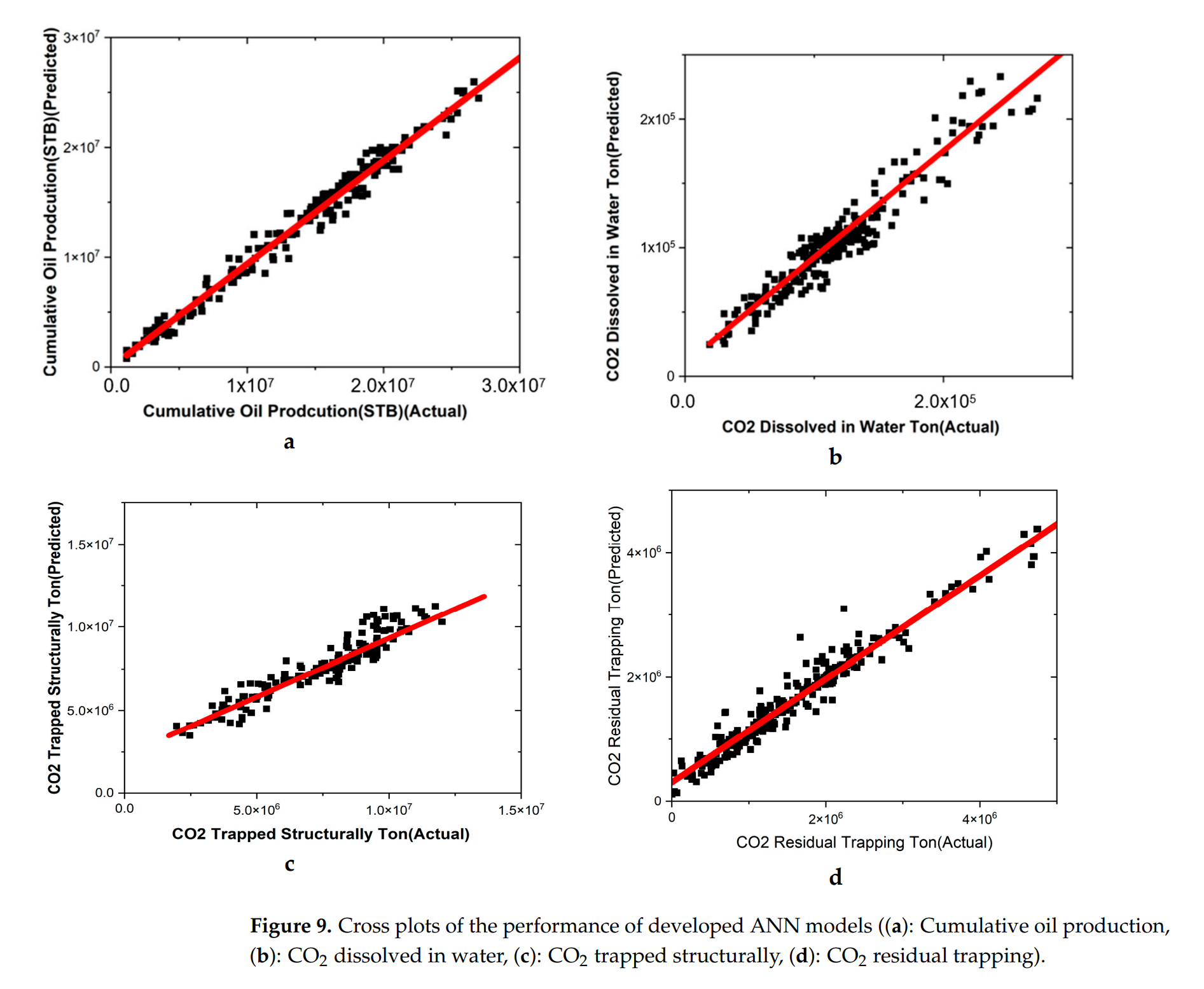
- 模型精度高:ANN模型在预测CO₂驱采收率与封存效率方面表现优异,R²达0.98,误差低于10%,验证结果与实测数据高度一致。
- 参数敏感性分析:
- 垂向/水平渗透率比(Kv/Kh)增加可提高采收率,但会降低CO₂封存率;
- 注入速率、孔隙度、渗透率与采收率和封存量呈正相关;
- 高矿化度抑制CO₂溶解封存;
- 生产井底流压与采收率负相关,但与CO₂封存量正相关。
- 最优操作条件:推荐生产井底流压为1250 psi,CO₂注入速率为14–16 MMSCF/D,可在保障采收率的同时控制CO₂突破。
- 方法通用性强:虽然模型基于Permian盆地ROZ数据训练,但所提出的“模拟+机器学习”框架可推广至其他油藏类型,只需重新训练即可应用。
- 研究展望:未来可扩展至更复杂油藏(如页岩、裂缝性油藏)及不同温压条件下,进一步提升模型适用性与泛化能力。
作者单位
美国休斯顿大学 石油工程系
Abstract
Residual oil zones (ROZ) arise under the oil–water contact of main pay zones due to diverse geological conditions. Historically, these zones were considered economically unviable for development with conventional recovery methods because of the immobile nature of the oil. However, they represent a substantial subsurface volume with strong potential for CO2 sequestration and storage. Despite this potential, effective techniques for assessing CO2-EOR performance coupled with CCUS in ROZs remain limited. To address this gap, this study introduces a machine learning framework that employs artificial neural network (ANN) models trained on data generated from a large number of reservoir simulations (300 cases produced using Latin Hypercube Sampling across nine geological and operational parameters). The dataset was divided into training and testing subsets to ensure generalization, with key input variables including reservoir properties (thickness, permeability, porosity, Sorg, salinity) and operational parameters (producer BHP and CO2 injection rate). The objective was to forecast CO2 storage capacity and oil recovery potential, thereby reducing reliance on time-consuming and costly reservoir simulations. The developed ANN models achieved high predictive accuracy, with R2 values ranging from 0.90 to 0.98 and mean absolute percentage error (MAPRE) consistently below 10%. Validation against real ROZ field data demonstrated strong agreement, confirming model reliability. Beyond prediction, the workflow also provided insights for reservoir management: optimization results indicated that maintaining a producer BHP of approximately 1250 psi and a CO2 injection rate of 14–16 MMSCF/D offered the best balance between enhanced oil recovery and stable storage efficiency. In summary, the integrated combination of reservoir simulation and machine learning provides a fast, technically robust, and cost-effective tool for evaluating CO2-EOR and CCUS performance in ROZs. The demonstrated accuracy, scalability, and optimization capability make the proposed ANN workflow well-suited for both rapid screening and field-scale applications.
