
Subsurface thermal energy recovery from depleted heavy oil reservoir after in-situ combustion operations and its implication on CO2 storage
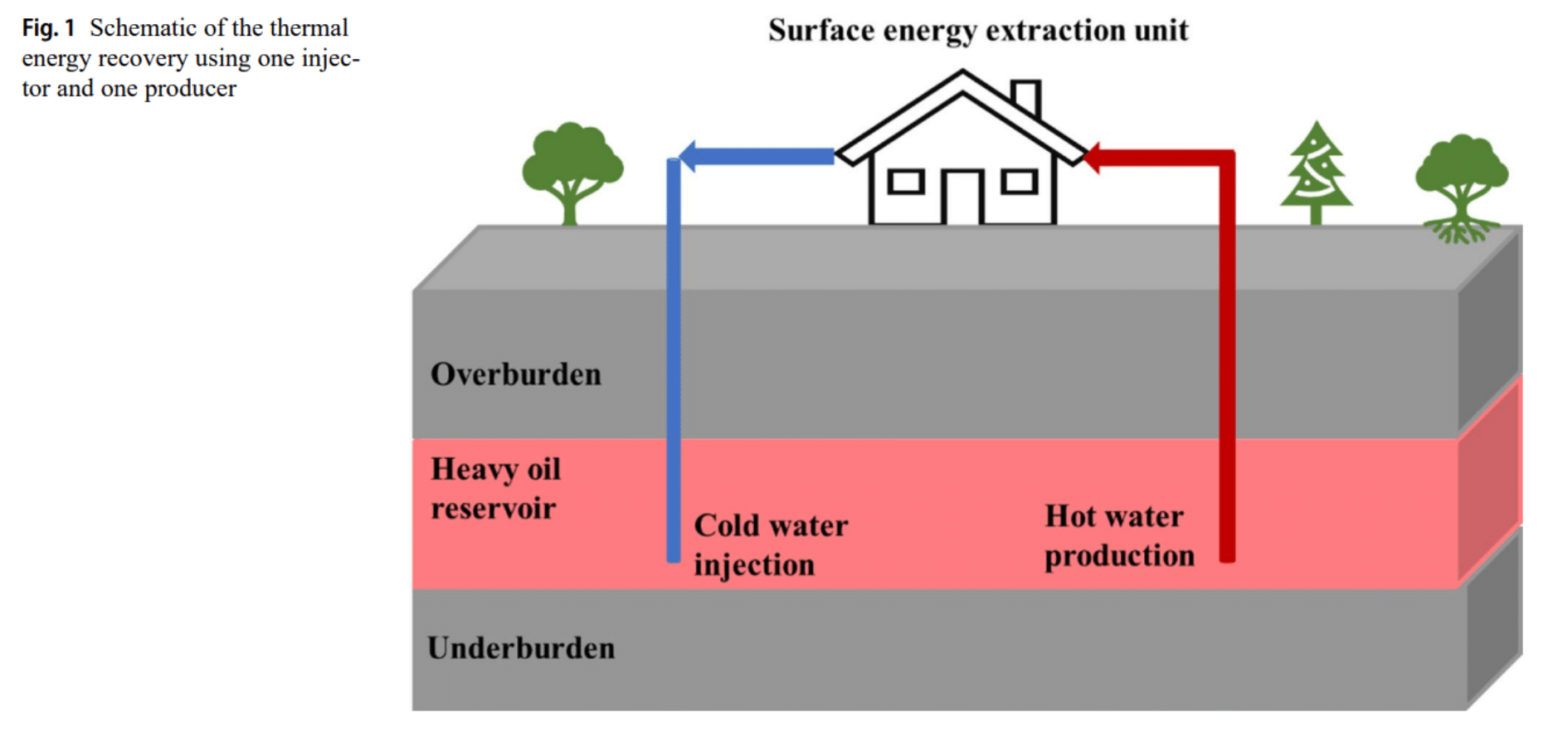
火烧油层(ISC)在开采稠油资源方面具有巨大潜力且环境足迹较小。在ISC作业结束时,储层中仍留有大量热能。通过适当回收ISC后枯竭储层中的热能,可以延长稠油储层的经济寿命。本研究探讨了使用冷水和CO₂作为工质提取热能的潜力,以推进ISC后枯竭储层中热能回收与CO₂封存的知识基础。提取的流体被输送到地面二元循环用于发电或区域供热。
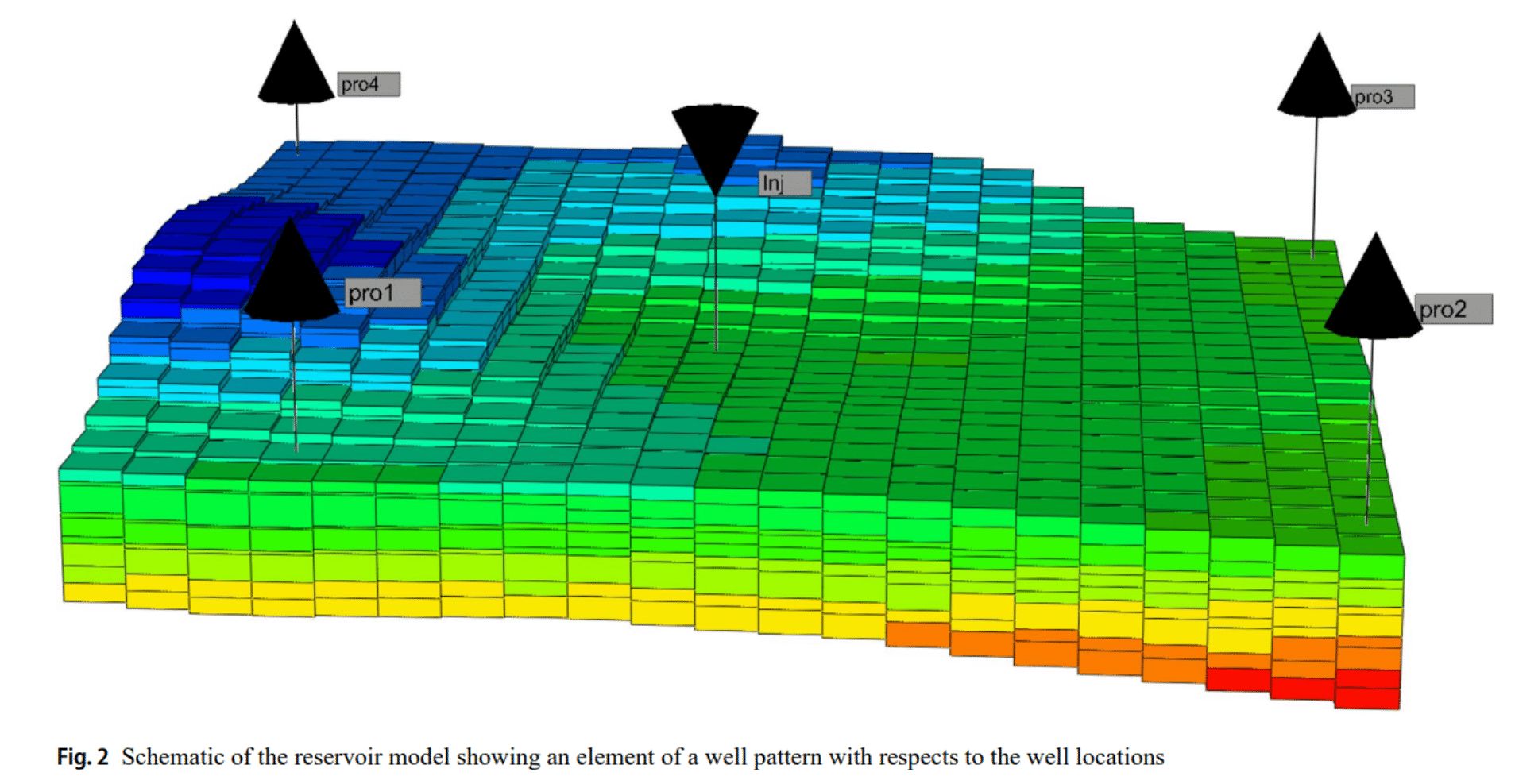
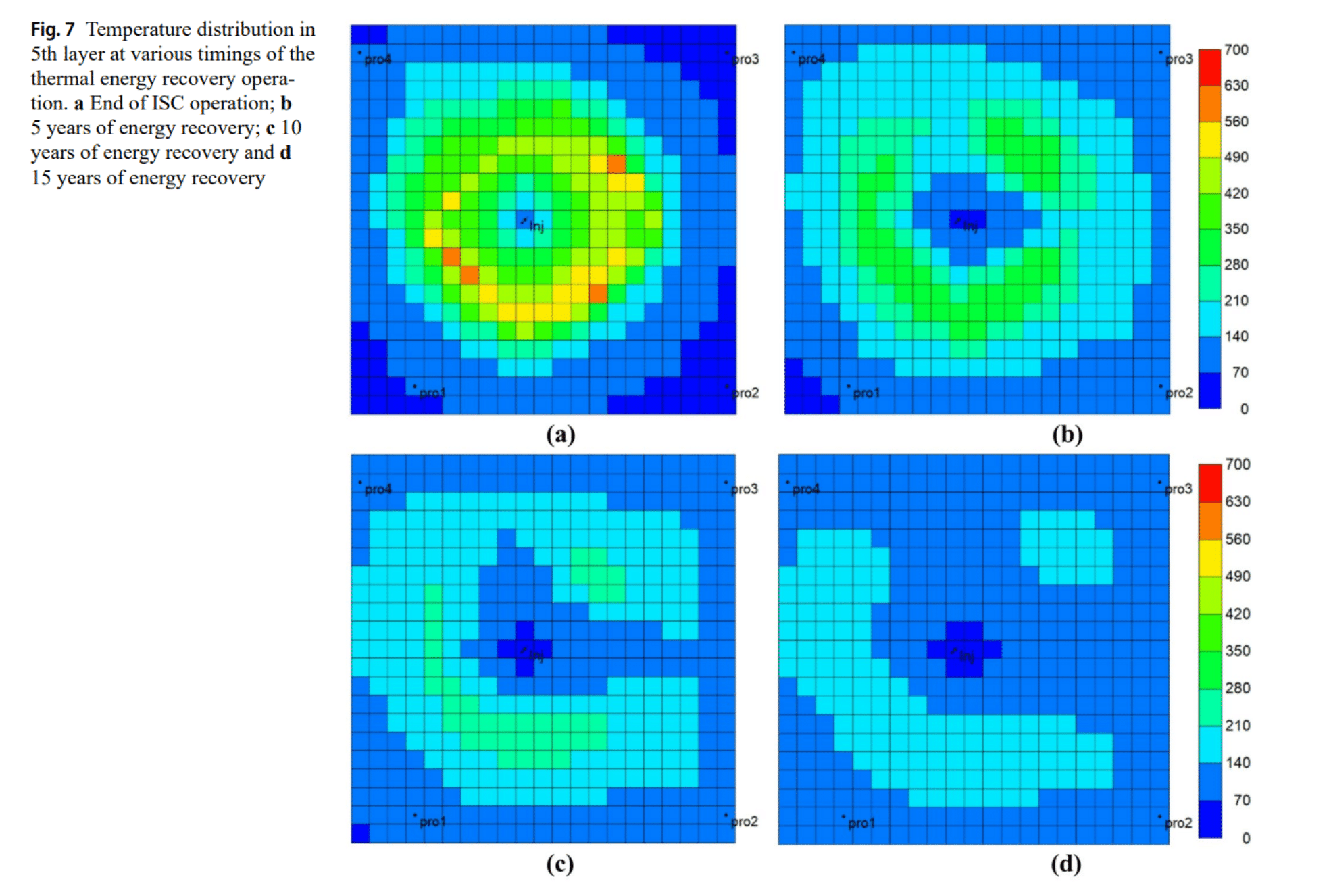
研究进行了ISC模拟,以估算20年石油生产后的温度、能量和流体分布,并评估了储层中剩余能量。估计在典型五点井网中,ISC作业后地下仍留有3×10¹⁴ J的热能。随后,通过将冷水和CO₂重新注入储层进行能量回采。
结果表明,ISC作业后的稠油储层可被视为用于地下热能提取的人工地热系统。随着水循环速率从200 m³/天增加到400 m³/天和600 m³/天,平均储层温度分别降至95°C、79°C和71°C,相应的热能回采率分别为48%、63%和77%。较大的水循环速率可在ISC后产生高能量输出和高能量回收。热能回采可将枯竭储层的能源生产延长至15-20年。
除热能提取外,使用CO₂作为工质在五口井网中可封存总计6100吨CO₂。本研究的数值研究表明,在全油田规模可实现巨大的能量提取潜力和CO₂封存。ISC后利用地下热能是抵消运营成本、减少CO₂排放和延长储层经济寿命的有益选择。
CMG软件应用情况
使用软件:CMG STARS(商业热采储层模拟器)
具体应用环节:
- 三维储层模型建立与ISC过程模拟
- 建立了考虑储层非均质性的三维储层模型
- 使用CMG STARS进行为期20年的ISC过程模拟,以估算油产量、温度分布及地下剩余能量
- 模型与现场数据进行了验证,油速的均方根误差(RMSE)为0.558,表明模型可提供合理结果
- 热能回采过程模拟
- CMG STARS完全耦合了质量平衡和能量平衡方程
- 能够考虑多组分、流体流动动力学、质量传递、热传递、化学反应、向盖层/底层的散热等因素
- 具备模拟ISC过程和后续热能回收过程的能力
- 采用简化的反应动力学模型(包含4个化学反应:低温氧化和高温氧化反应)以提高计算效率
- 敏感性分析与优化
- 研究了不同冷水注入速率(200、400、600 m³/天)对能量回收性能的影响
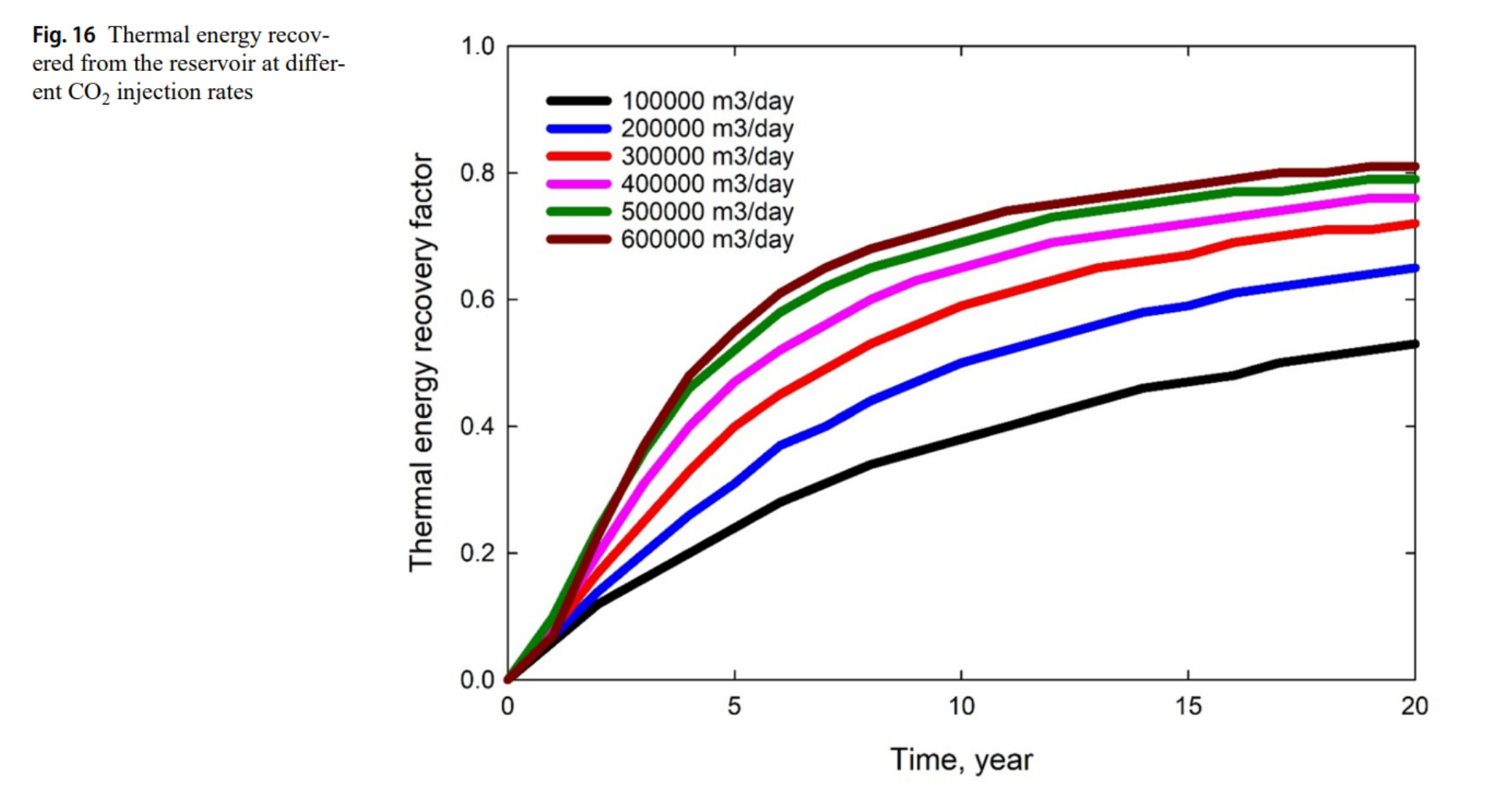
- 研究了不同CO₂注入速率(100,000至600,000 m³/天)对热能回收和CO₂封存的影响
- 评估了储层平均温度、净储层能量、热能回收因子、流体滞留量等关键参数
- CO₂封存机制评估
- 模拟了构造圈闭、残余圈闭和溶解圈闭三种CO₂封存机制
- 评估了不同注入速率下的CO₂封存量(最高达6100吨)
主要结论
- 储层热能潜力:ISC作业结束后,典型五点井网中地下仍留有3×10¹⁴ J的热能,若不加以利用将散失到周围地质构造中。ISC后的枯竭稠油储层可被视为人工地热储层,平均温度高达200°C(燃烧前缘波及区高于450°C)。
- 冷水作为工质:
- 注入速率200 m³/天:热能回收率48%,约44%能量仍留在地下,不到8%散失到盖层/底层
- 随着注水速率增加至400 m³/天和600 m³/天,平均储层温度分别降至95°C、79°C和71°C,热能回采率分别提升至63%和77%
- 最优水注入量为400 m³/天,对应的平准化热能成本(LCoH)为**0.34 /kWh和600 m³/天的0.40 $/kWh)
- CO₂作为工质:
- 随着CO₂循环速率从100,000 m³/天增加到600,000 m³/天,热能回采率从52%提升至81%
- 使用CO₂作为工质可在五口井网中封存总计6100吨CO₂,在全油田规模具有巨大封存潜力
- CO₂封存机制包括构造捕集、残余捕集和溶解捕集
- CO₂注入有助于将储层压力建立至初始储层压力(利用CO₂高压缩性优势)
- 工程经济性:热能回收可将枯竭储层的能源生产延长至15-20年。ISC后利用地下热能是抵消运营成本、减少CO₂排放和延长储层经济寿命的有益选择,可利用现有井筒和地面设施,避免额外钻井成本。
- 研究局限:未考虑CO₂矿化作用(长期封存机制),未来研究将延长至100年时间尺度以评估矿化封存机制,并将开展水-CO₂混合注入优化研究。
Abstract
In-situ combustion (ISC) has a huge potential in recovering heavy oil resources with a low environmental footprint. At the end of the ISC operation, a huge amount of thermal energy is left in the reservoir. By appropriately recovering the thermal energy in the depleted reservoirs after ISC operation, it could extend the economic life of the heavy oil reservoirs. This work investigated the potential of extracting heat using the cold water and CO2 as the working fluids to advance the knowledge base regarding the thermal energy recovery and CO2 storage in depleted ISC reservoirs. The extracted fluids are fed to the surface binary cycle for power generation or district heating. Simulation of ISC was performed to estimate the temperature, energy, and fluids distributions after 20 years of the oil production. An assessment of the energy remaining in the reservoir is performed. It is estimated that a total of 3 × 10¹⁴ J thermal energy was left underground after ISC operation in the typical five-spot well pattern. Subsequently, an examination of the potentially recoverable energy from the post ISC operation is performed. Cold water and CO2 are recirculated into the reservoir for energy recovery. The results indicates that the heavy oil reservoir after ISC operation can be regarded as an artificial geothermal system for subsurface thermal energy extraction. As the water circulation rate increases from 200 m3/day and to 400 m3/day and 600 m3/day, the average reservoir temperature is declined to 95 ℃, 79 ℃, and 71 ℃, respectively. Meanwhile, the corresponding thermal energy recovery factors are 48%, 63%, and 77%, respectively. Larger water circulation rate can generate high energy output and high energy recovery in the post ISC operation. The thermal energy recovery could prolong the energy production to 15 to 20 years in a depleted reservoir. Except for thermal energy extraction, a total of 6100 tons of CO2 can be sequestrated underground by using the CO2 as the working fluids in the five spot well pattern. The numerical investigation in this study indicate that huge energy extraction potential and CO2 storage can be achieved at the full field scale. Utilization of subsurface thermal energy after the ISC operation is a beneficial choice to offset the operating costs, reduce the CO2 emission and extend the economic life of reservoir.
