
A robust deep learning framework for predicting carbon dioxide-water alternating gas injection performance and optimization
二氧化碳(CO₂)排放是重大环境问题,CO₂-水气交替(WAG)注入是一种既能提高原油采收率又能将CO₂封存在地下储层的技术。然而,WAG项目的性能受注入速度、周期大小和比例等多种参数影响,传统方法需要进行大量计算昂贵的数值模拟。
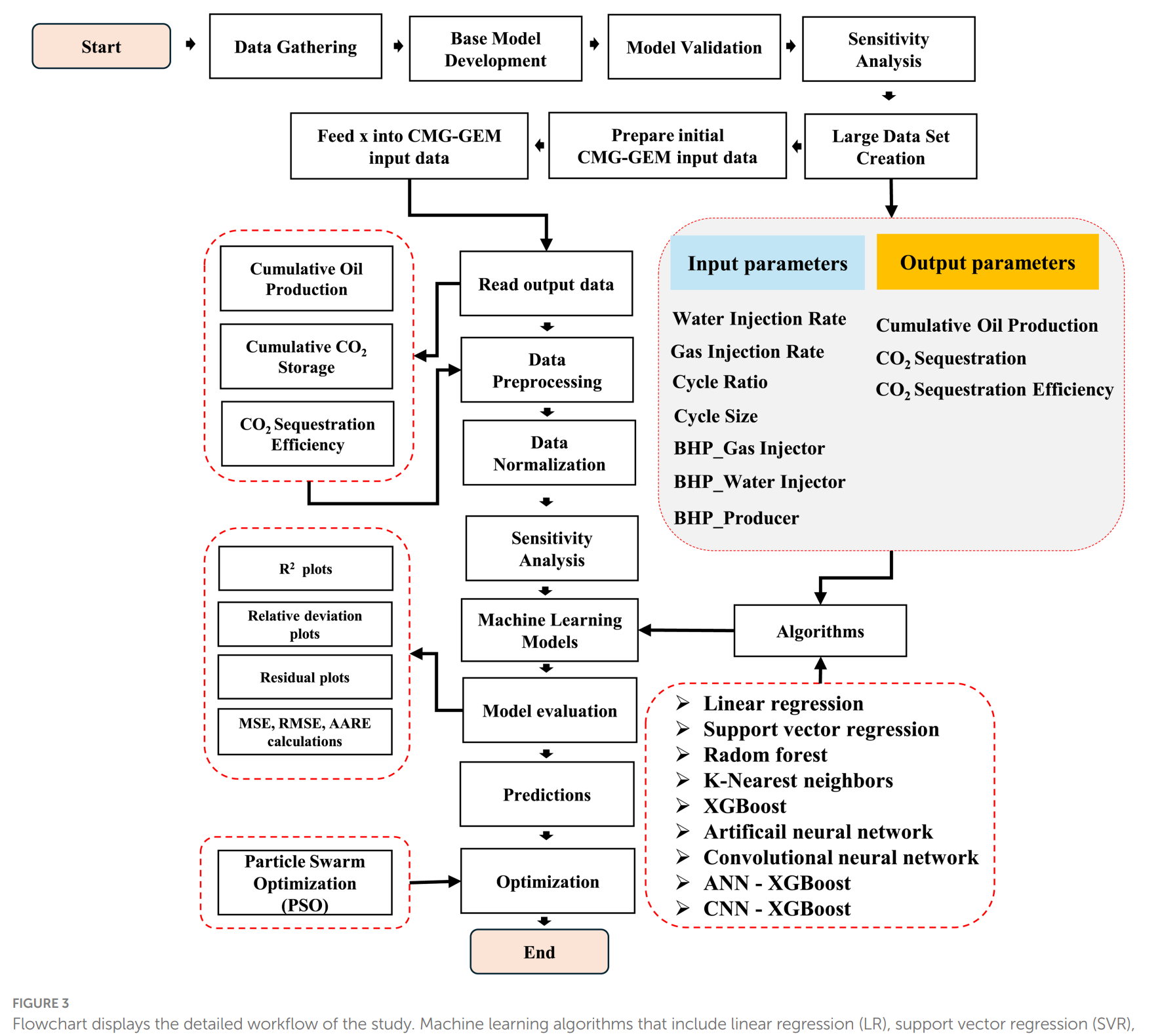
本研究基于Bell Creek地层特性,利用CMG-GEM数值模拟器生成2,400个样本的数据集,建立了稳健的机器学习工作流。研究测试了极端梯度提升(XGBoost)、线性回归(LR)、随机森林(RF)、K近邻(KNN)、支持向量回归(SVR)、人工神经网络(ANN)、卷积神经网络(CNN)以及混合模型(ANN-XGBoost、CNN-XGBoost)等算法,用于预测CO₂-WAG性能。
结果表明,ANN-XGBoost混合模型表现最优,预测累计产油量、CO₂封存量和封存效率的R²分别达到0.99159、0.97515和0.98706,对应的RMSE分别为2.8×10⁻²、1.5×10⁻¹和2.4×10⁻²。将该代理模型与粒子群优化(PSO)算法耦合后,累计产油量提高12.8%,CO₂封存量增加11%。
在计算速度方面,传统数值模拟器每个场景需4-5分钟,而本工作流完成预测和优化仅需不到1分钟。这些发现验证了所提出的机器学习工作流在预测CO₂-WAG性能和优化方面的稳健性和计算效率。
CMG软件应用情况
软件版本:CMG-GEM(2022版)组分模拟器
模型建立:
- 基于Bell Creek地层特性构建基础地质模型,模拟真实储层条件
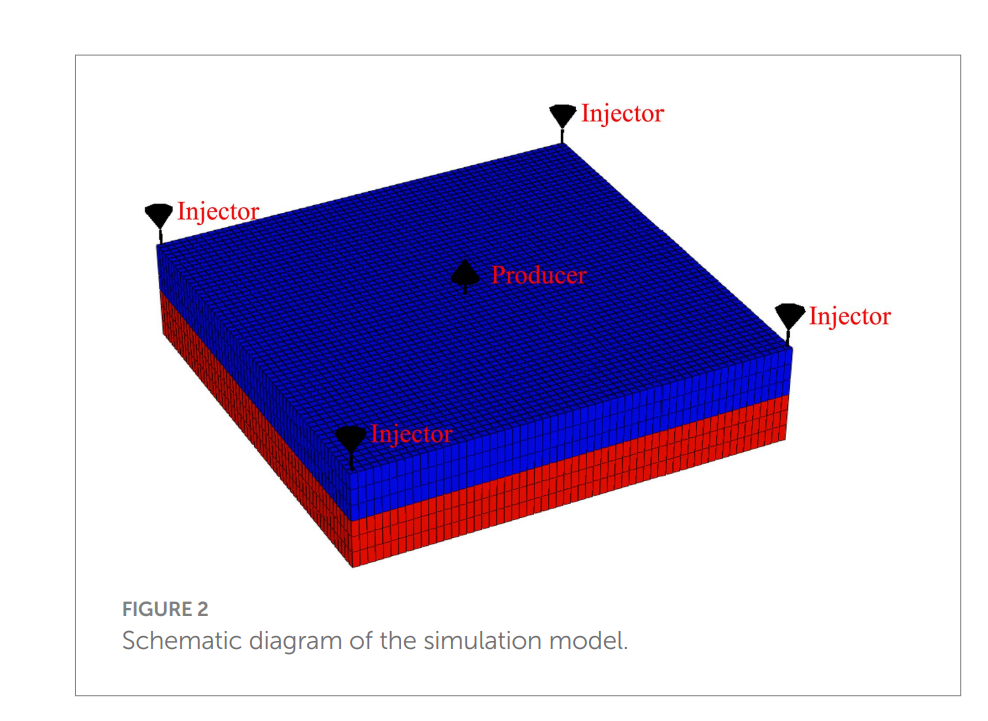
- 采用五点法井网设计:1口中心生产井 + 4口角部注入井(水井/气井交替)
- 网格系统:59×59×6,共20,886个网格块
- 模型倾角1°,深度1,342m,初始压力2,400 psi,温度41.7°C
- 采用双孔双渗模型:上部粉砂岩(孔隙度0.15,渗透率50 md),下部砂岩(孔隙度0.25,渗透率700 md)
- 垂向渗透率与水平渗透率比值(Kv/Kh)为0.1
流体与物性参数:
- 使用Peng-Robinson状态方程进行流体模型拟合
- 将组分归并为7个拟组分(N₂-C₂、C₃-nC₄、iC₅-C₇、C₈-C₁₃、C₁₄-C₂₄、C₂₅-C₃₆+、CO₂)
- 应用CMG-GEM内置的线性相渗透率滞后模型(Land模型,Sgr,max=0.30)模拟残余捕集机制
- 模拟了构造捕集、溶解捕集、残余捕集和矿化作用(矿化作用因时间尺度长被忽略)
数据生成:
- 通过Python脚本自动生成2,400组CMG-GEM输入文件
- 输入参数包括:注气/注水压力、生产压力、WAG周期大小(1-18个月)、WAG比例(1.1-3.1)、注气速度(1-10×10⁴ m³/天)、注水速度(0.05-3×10³ m³/天)
- 输出参数:累计产油量、累计CO₂封存量、CO₂封存效率
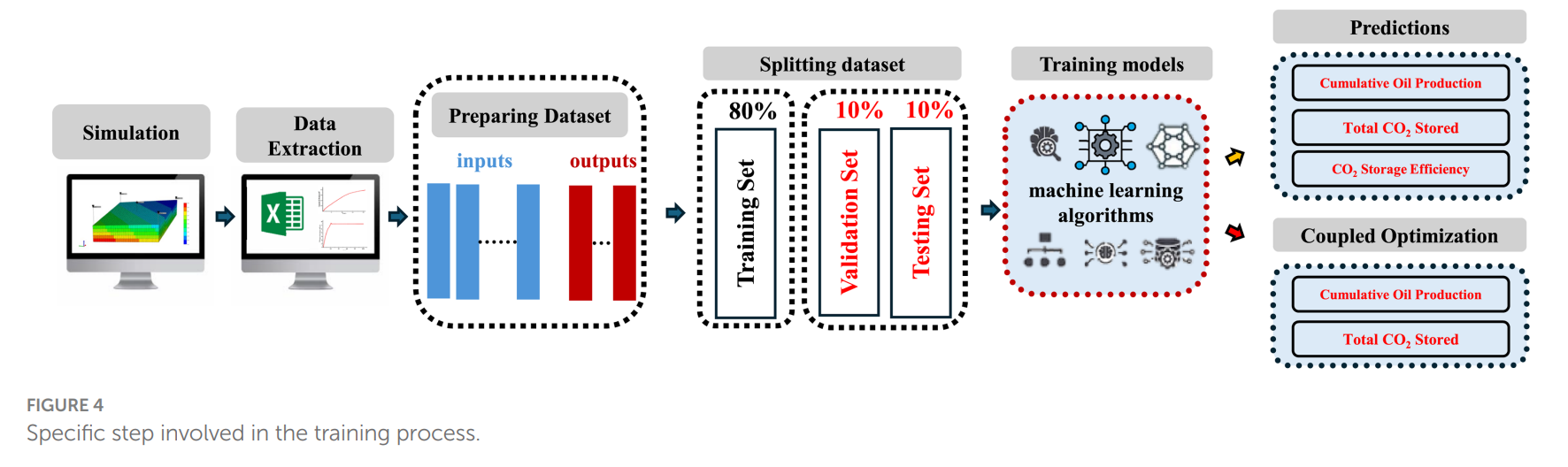
- 训练集80%(1,920个),验证集和测试集各10%(各240个)
计算效率对比:
- CMG-GEM单次模拟需4-5分钟,2,400次模拟总计需约180小时
- 构建的ANN-XGBoost代理模型单次预测<1秒,全部2,400个案例仅需10-15秒
主要结论
- WAG参数优化:CO₂-WAG周期大小和比例对产油和CO₂封存有显著影响。6个月的周期大小和1:1的WAG比例可获得更高的产油量和CO₂封存量。
- 注入速度影响:注水和注气速度对产油和CO₂封存有强烈影响,但需谨慎设计。盲目提高注入速度会导致早期水窜或气窜,而优化后的注水速度2.7×10² m³/天和注气速度8.53×10⁴ m³/天可获得最佳效果。
- 模型性能:在九种测试的机器学习算法中,ANN-XGBoost混合模型预测精度最高,能够准确捕捉复杂非线性关系,且无明显过拟合现象。
- 优化效果:ANN-XGBoost代理模型与PSO优化算法耦合后,相比基础WAG案例,累计产油量从1.1×10⁶桶提高至1.3×10⁶桶(+12.8%),CO₂封存量从4.53×10⁵吨提高至5.56×10⁵吨(+11%)。
- 计算效率:提出的优化框架仅需几分钟即可完成预测和优化,而传统数值模拟方法需要数小时,为工程师提供了快速可靠的CO₂-WAG操作决策支持工具。
- 应用拓展:该框架不仅适用于CO₂-WAG,还可扩展至化学驱、地热储层工程、地下水修复及地下储氢等类似优化问题。
作者单位
中国石油大学(北京)

Abstract
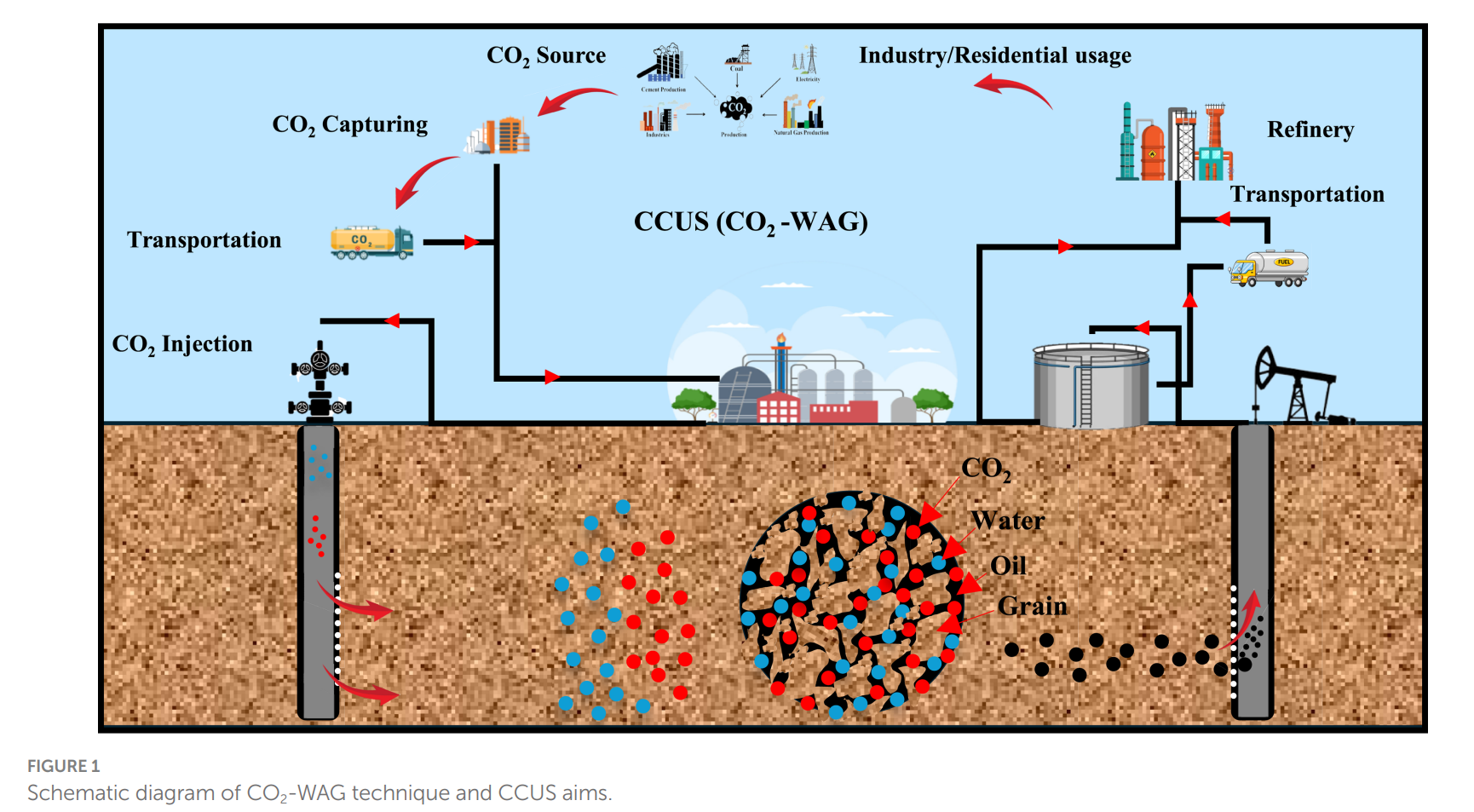
Carbon dioxide (CO2) emissions pose a major environmental concern, and various methods are used for CO2 sequestration. CO2-water activating gas (CO2-WAG) injection is a technique used to increase production of oil and sequester CO2 in subsurface formations. However, the performance of the CO2-WAG project depends on various parameters, such as injection rates, cycle size, and ratio, that traditionally require numerous computationally expensive simulations. The study introduces a robust machine learning workflow for CO2-WAG performance prediction and optimization by using a model calibrated using Bell Creek formation properties. Machine learning models are based on algorithms like extreme gradient boosting (XGBoost), linear regression (LR), random forest (RF), k-nearest neighbor (KNN), support vector regression (SVR), artificial neural network (ANN), convolutional neural network (CNN), and hybrid models such as ANN and CNN coupled with XGBoost (ANN-XGBoost, and CNN-XGBoost) to predict CO2-WAG performance. A dataset of 2,400 samples was generated using the CMG-GEM numerical simulator, incorporating seven input parameters (e.g., injection rate, CO2-WAG cycle size, and WAG ratio) and three output parameters, with 80% of the dataset allocated for training and 20% for validation and testing. Among the proposed models, the hybrid model ANN-XGBoost demonstrated superior performance, accurately predicting total oil production, CO2 storage, and efficiency, with high R2 scores of 0.99159, 0.97515, and 0.98706, and corresponding lower RMSE values of 2.8 × 10⁻², 1.5 × 10⁻¹, and 2.4 × 10⁻². Coupling the proxy with particle swarm optimization (PSO) yielded 12.8% increase in cumulative oil production and 11% increase in CO2 storage. Furthermore, in terms of speed, the projected workflow requires less minutes to complete predictions and optimization, while traditional numerical simulators require 4–5 min per scenario. These findings validates the robustness and computational efficiency of the proposed machine learning workflow for predicting CO2-WAG performance and optimization.
