
Thermal Hydraulic Mechanical Embed-to-Control-and-Observe (THM-E2CO): Toward Real-Time Surrogate Modeling of Geothermal Systems
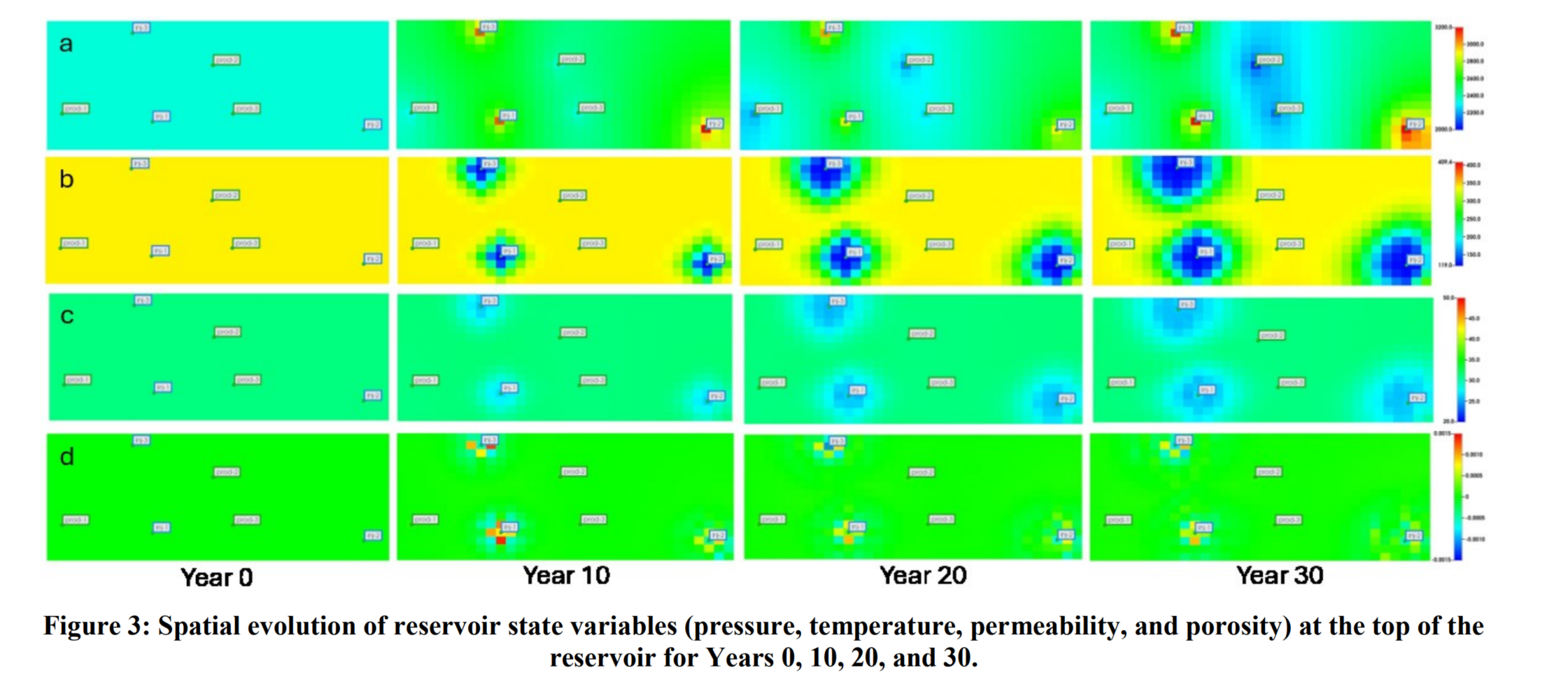
本研究提出了一种深度学习框架——热-流-固嵌入控制观测(THM-E2CO),专为受紧密耦合孔隙热弹性过程控制的地热储层高保真降阶模拟而设计。该架构扩展了E2CO范式,以解决传热、流体流动与岩石变形之间复杂的非线性相互作用问题。与静态代理模型不同,该框架专门用于预测和捕捉孔隙度和渗透率随时间演化的过程,以响应热采出和机械载荷作用下的变化。
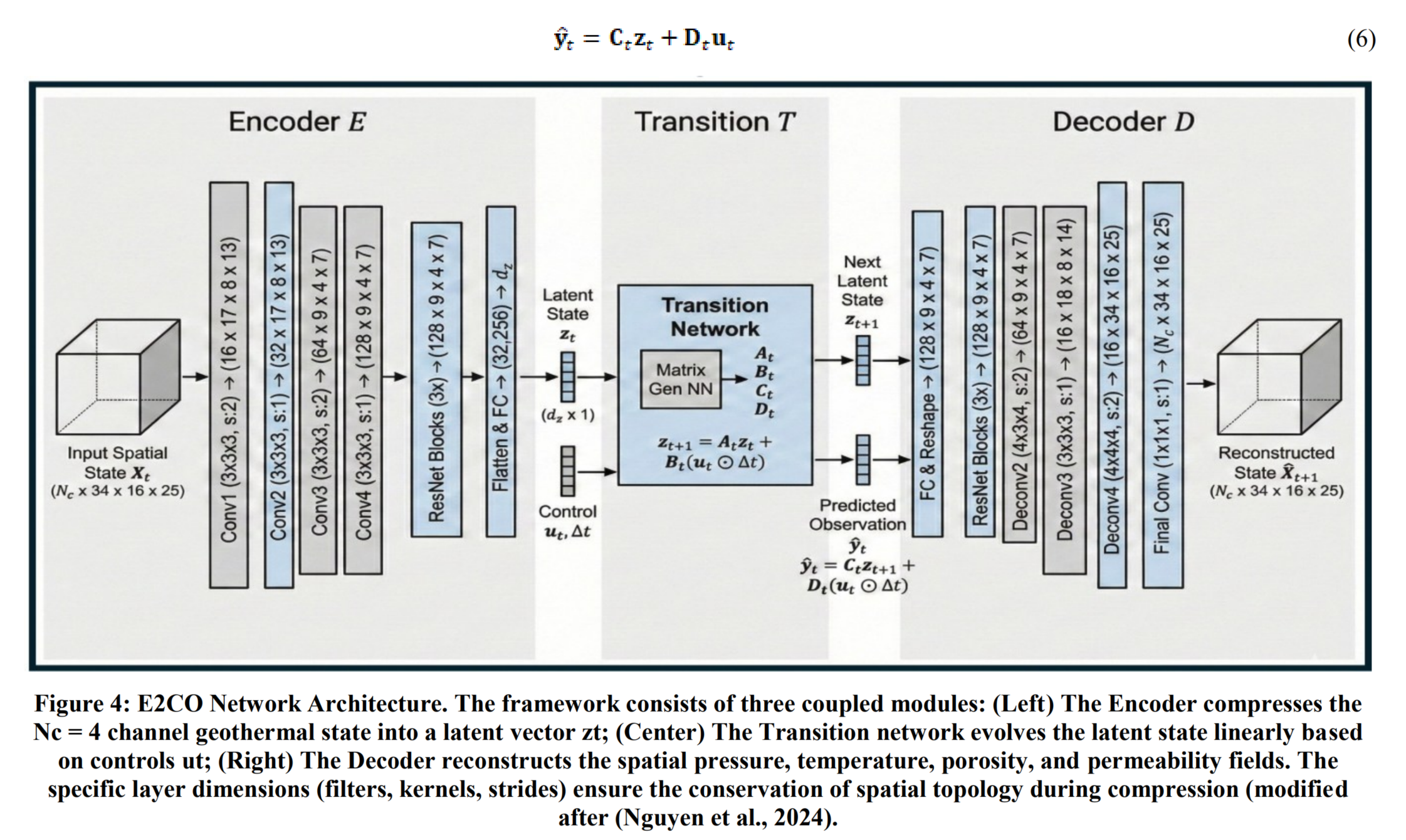
THM-E2CO架构集成了三维卷积编码器-解码器,用于压缩和重建全场地压力和温度分布,同时保留关键的热-水力-力学耦合关系。非线性潜状态转移网络模拟储层在不同操作控制下的时间演化。关键的是,该模型被训练用于观测温度梯度和孔隙压力波动驱动机械变形、进而改变岩石基质流动特性的反馈回路。学习过程通过复合损失函数进行正则化,该函数强制执行数据重建保真度、潜状态一致性以及质量和能量守恒,确保耦合物理场的物理合理性。
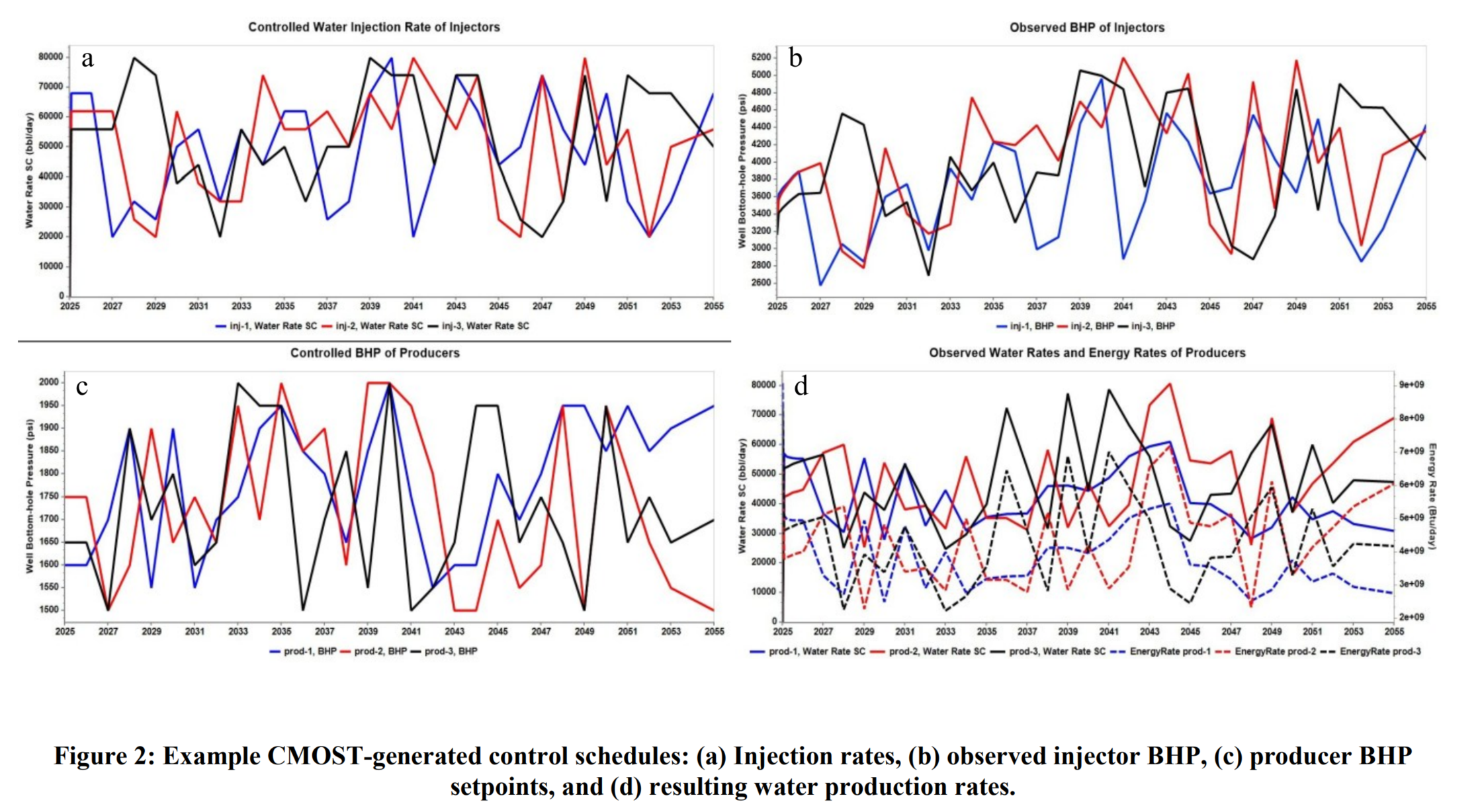
使用CMG STARS作为高保真模拟器,通过CMOST驱动注入速率和生产井底压力变化,生成了多样化的训练数据集合。数据集包含超过1,000次模拟,涵盖30年生产期,采用六井配置(三口注入井、三口生产井)。这一广泛的操作空间使模型能够学习稳健的耦合行为以及储层传导性随时间的非线性退化或增强过程。
本工作的创新之处在于框架能够显式捕捉储层的孔隙热弹性响应,为计算昂贵的地质力学求解器提供了快速替代方案。通过将应力相关渗透率物理嵌入潜空间,模型实现了对全物理模拟的高保真再现,计算加速超过30,000倍。这一发展为快速地热性能预测、不确定性量化和复杂地质力学条件下的实时优化提供了可扩展的基础。
CMG软件应用情况
| 应用领域 | 具体功能 | 技术细节 |
|---|---|---|
| 高保真模拟器 | CMG STARS | 作为训练数据生成的基准全物理模拟器 |
| 自动化采样 | CMOST | 拉丁超立方采样(LHS)生成操作控制参数 |
| 热采模拟 | 地热储层THM耦合 | 单相热水储层,30年生产周期 |
| 地质力学模块 | 3D地质力学计算 | 热弹性响应、应力初始化(正断层机制) |
| 流体性质 | 水物性计算 | 密度和焓值基于蒸汽表数据近似 |
CMG特色功能应用:
- STARS热采模拟器:处理地热系统中温度-压力-应力的强耦合非线性问题
- CMOST优化工具:自动化生成1,000个模拟案例的训练数据集
- 注入速率采样范围:20,000–80,000 BWPD(桶水/天)
- 生产井底压力采样范围:1,500–2,000 psi
- 动态岩石物性:孔隙度和渗透率随有效应力和温度变化实时更新
- 热物性计算:内置蒸汽表数据用于亚临界水密度和焓值计算
模型配置参数:
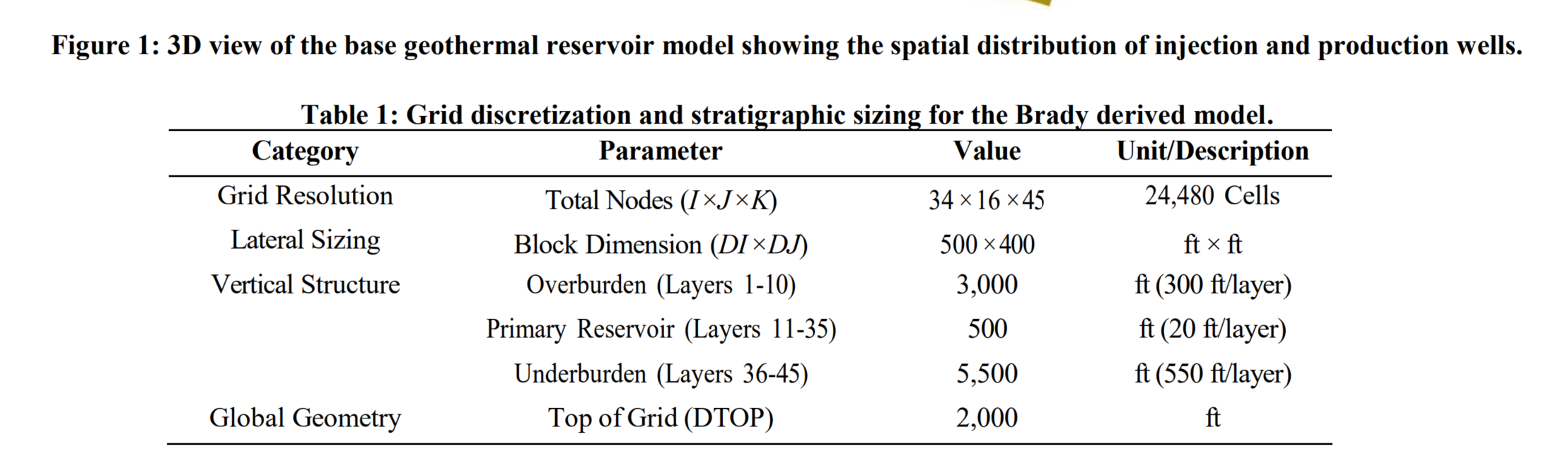
- 网格规模:34 × 16 × 45 = 24,480个网格单元
- 储层厚度:500 ft(主储层段)
- 水平渗透率:11.35–162.5 mD
- 垂向渗透率:水平渗透率的0.1倍(各向异性)
研究结论
- 计算效率突破:THM-E2CO模型实现30,000倍以上的计算加速,单次预测仅需0.03秒,而CMG STARS全物理模拟需要约15分钟
- 预测精度:
- 注入井底压力:R² ∈ [0.92, 1.00],平均百分误差(APE)∈ [0.72%, 3.28%]
- 生产能量速率:R² ∈ [0.85, 1.00],APE ∈ [0.57%, 9.42%]
- 产水速率:R² ∈ [0.89, 0.98],APE ∈ [4.52%, 8.04%]
- 动态物性捕捉:成功将孔隙度和渗透率作为动态状态变量建模,准确捕捉热采出和机械载荷引起的岩石物性反馈效应
- 工程应用价值:为实时地热性能预测、不确定性量化和闭环储层管理提供了可扩展的技术基础
- 方法创新:首次将E2CO框架扩展至地热THM系统,突破了现有代理模型将孔隙度/渗透率视为静态场的局限
研究亮点与局限性
主要创新:
- 将应力相关渗透率物理嵌入潜空间表示
- 实现全场地3D状态(压力、温度、孔隙度、渗透率)的统一预测
- 两种预测模式:状态模式(高保真)和潜空间模式(高效率)
框架局限:
- 长期预测存在自回归误差累积(20-30年以上)
- 假设井位固定,无法泛化到新井位配置
- 需要大量训练数据(约10³次全物理模拟)
- 物理感知损失函数增加计算开销
发表信息:
- 会议:第51届斯坦福大学地热储层工程研讨会(51st Workshop on Geothermal Reservoir Engineering)
- 时间:2026年2月9-11日
- 地点:斯坦福大学,加利福尼亚州
- 论文编号:SGP-TR-230
作者信息
Taha Yehia德克萨斯A&M大学石油工程系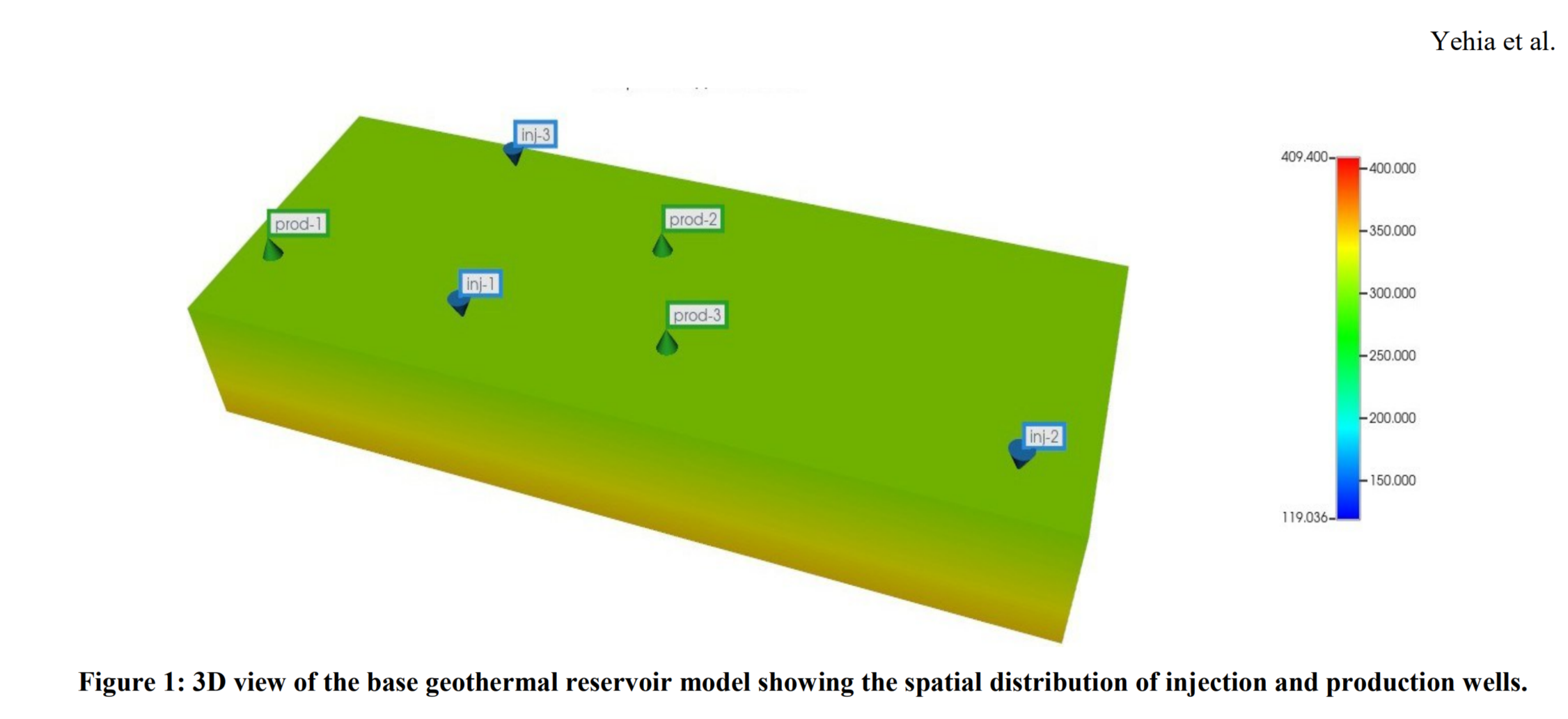
ABSTRACT
This study presents a deep learning framework, Thermal-Hydraulic-Mechanical Embed-to-Control-and-Observe (THM-E2CO), designed for high-fidelity reduced-order modeling of geothermal reservoirs governed by tightly coupled poro-thermo-elastic processes.The architecture extends the E2CO paradigm to address the complex nonlinear interactions between heat transfer, fluid flow, and rock deformation. Unlike static surrogate models, this framework is specifically engineered to predict and capture the temporal evolution of porosity and permeability as they respond to thermal drawdown and mechanical loading within the reservoir.
The THM-E2CO architecture integrates a 3D convolutional encoder-decoder to compress and reconstruct full field pressure and temperature distributions while preserving critical thermal-hydraulic-mechanical couplings. A nonlinear latent-state transition network
models the temporal evolution of the reservoir under varying operational controls. Crucially, the model is trained to observe the feedback loops where temperature gradients and pore pressure fluctuations drive mechanical deformation, subsequently altering the
flow properties of the rock matrix. The learning process is regularized through a composite loss function that enforces data reconstruction fidelity, latent consistency, and conservation of mass and energy, ensuring physical plausibility across the coupled
domains.
Using CMG STARS as the high-fidelity simulator, a diverse ensemble of training data was generated via CMOST-driven variations in injection rates and producer bottom hole pressures. The dataset comprises over 1,000 simulations spanning a 30-year production period,
featuring a six-well configuration. This wide operational space allows the model to learn robust coupled behavior and the nonlinear degradation or enhancement of reservoir transmissibility over time. The novelty of this work lies in the framework’s ability to explicitly capture the poro-thermo-elastic response of the reservoir, providing a rapid alternative to computationally expensive geomechanical solvers. By embedding the physics of stress-dependent permeability into the latent space, the model achieves high-fidelity reproduction of full physics simulations with computational accelerations exceeding 30,000 times. This development provides a scalable foundation for the prediction of rapid geothermal performance, uncertainty quantification, and real time optimization under complex geomechanical conditions.
