SIMULATION OF CO2 SEQUESTRATION IN DEEP SALINE AQUIFERS
摘要
- 近几十年来,由于在发电和炼油厂、水泥厂、钢铁生产等其他工业过程中使用化石燃料,二氧化碳排放量一直在不断增加。
- 在这一过程中,每家发电厂每年排放数百万吨二氧化碳。二氧化碳封存是公认的减少大气中二氧化碳排放并将其长时间储存在地下的最佳方法之一。人们已经提出了许多在地下封存二氧化碳的方法(Greenhouse Gas R&D Programme IEA, 2008)。按储存能力划分,其中最可行的封存地点是枯竭的油气藏、无法开采的煤层和深层盐水层。
- 深层盐水层是储存二氧化碳的最佳封存地点,因为盐水层存在于世界上大多数地区,而且其储存容量很大。目前对盐水层的研究还不够深入,因此,为了更好地了解饱和水的砂岩地质情况,以及砂岩上方作为流动屏障的页岩,人们正在进行更多的研究。而对于地层中CO2和盐水的溶解度以及化学反应的研究,则较为完善。
- 本项目介绍了犹他州Gordon Creek油田的盐水层CO2封存的模拟研究。本次项目是二氧化碳封存的试点项目前驱,在4年内注入二氧化碳294万吨。利用模拟来表征地质构造、水特征、储层流动特性、盖层特征的影响程度,并确定Navajo和Entrada砂岩的合理注入目标。利用Nexus中的GRIDGENR模块和Navajo地层的初级构造等高线图以及目标区域的测井曲线,建立了该区域的模拟模型。利用LESA测井分析软件和Gordon Creek 1号井的测井资料确定了岩石物理性质。利用CMG软件模拟了CO2注入含水层的过程。
- CMG用于模拟气体捕集过程中的残余气饱和度、CO2在盐水中的溶解度以及水、岩石和CO2中矿物之间的化学反应。研究人员分析了不同封存机制下的储存二氧化碳能力、流入储层的流向和密封性能。试点项目的注入目标也得到了验证。
- 本次项目对最重要的储层参数进行了敏感性分析,包括盐水矿化度、温度、残余气饱和度和初始压力。定量研究了这些参数对CO2溶解封存和束缚封存两种机制的影响。
关键词:
CO2封存、构造封存、束缚封存、溶解封存、矿化封存、Gordon Creek油田、油藏数值模拟、CMG软件、敏感性分析。
ABSTRACT
CO2 emissions during recent decades have been increasing due to the use of fossil fuels in the generation of electricity and other industrial processes like oil refineries, cement works, and iron and steel production.
Each power plant emits several millions of tons of carbon dioxide annually during this process. CO2 sequestration has been proposed as one of the best ways to reduce these emissions from the atmosphere and keep them stored underground for long periods of time. Numerous methods of capturing CO2 underground have been proposed (Greenhouse Gas R&D Programme IEA, 2008). The most viable due to their storage capacity, are depleted oil and gas fields, unminable coal seams, and deep saline Aquifers.
Deep saline aquifers are considered the best reservoirs to storage CO2, because they exist in most regions of the world and they have a large capacity of storage. These types of reservoirs have not been studied deeply and for that reason more research is being performed to get a better idea of the geology of sand formations saturated with water, as well as, shale present above these formations which act as barriers to flow. Studies of the solubility and chemical reactions between the CO2 and brine present in the formations also have been completed.
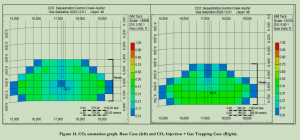
This project presents a simulation study for CO2 sequestration in a saline aquifer below the Gordon Creek Field in Utah. The presented work is a pre-cursor to a pilot project to inject up to 2.94 million tons of CO2 over a four year period. Simulations were used to characterize relative impacts of geologic structures, water characteristics, reservoir flow properties, seal formation characteristics and to identify reasonable injectivity goals for the Navajo and Entrada Sandstones.
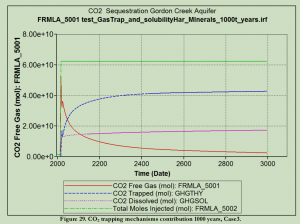
A simulation model of the area of interest was constructed using the GRIDGENR module of Nexus and preliminary structural contour maps of the Navajo formation and well logs of the zones of interest. Petrophysical properties were determined using the LESA log analysis software and well logs from the Gordon Creek No. 1 well. CMG simulator was used to model the injection of CO2 into the aquifer formations. CMG was used to model gas trapping due to residual gas saturation, solubility of CO2 into brine and chemical reactions between minerals present in the water, rock and CO2. Storage capacities of carbon dioxide for each trapping mechanism, flow direction into the reservoir and seal performance were analyzed over time. Injectivity goals for the pilot were also validated. Sensitivity Analyses for the most important reservoir parameters were accomplished for brine salinity, temperature, residual gas saturation and initial pressure. The effects of each one of those parameters in the total amount of CO2 trapped by solubility in water and residual gas saturation mechanisms were studied and quantified.
Keywords: CO2 Sequestration, Structural Trapping, Residual Gas Trapping, Solubility Trapping, Mineralization Trapping, Gordon Creek Field, Reservoir Simulation, CMG Software, Sensitivity Analysis.